
The flooring and surface industry is changing in ways that go well beyond product design and manufacturing. Buyers are spending more time researching online, businesses are managing increasingly complex product catalogs, and flooring companies are finding that their digital experience has to do much more than display products.
Table of Contents
Over the past several years, DotcomWeavers has worked with flooring, tile, stone, and industrial surface brands, including Wearwell, Wayne Tile, Nemo Tile, and Flooring Inc. That experience has given us a close view of how these businesses are adapting their digital operations to changing customer expectations, and five trends stand out in 2026.
| Digital trend | What is changing | Why it matters |
| Platform consolidation | Multiple brand websites are moving onto shared commerce platforms | Lower complexity and a more consistent customer experience |
| Digital visualization | Visualizers, configurators, and calculators are becoming part of product discovery | Helps buyers make high-consideration decisions online |
| B2B self-service | Industrial buyers are researching products and suppliers independently | Reduces dependence on sales for basic information |
| Educational content | Technical and comparison content is becoming a core digital asset | Builds search visibility and buyer confidence |
| Backend integration | ERP, PIM, tax, payment, and shipping systems are becoming tightly connected | Improves accuracy and removes customer-facing friction |
Together, these trends point to a larger shift: the flooring website is becoming an active part of the buying process rather than simply a digital catalog.
Trend 1: Multi-Brand Flooring Companies Are Consolidating Into One Platform
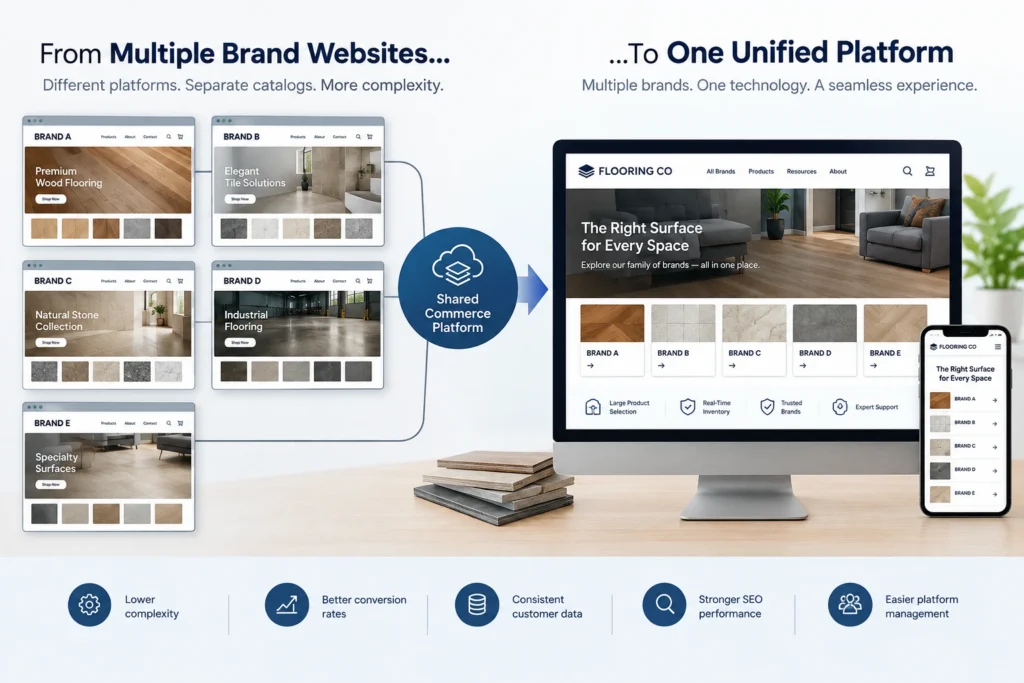
For flooring companies that have grown through acquisitions, new product lines, or multiple brands, maintaining a separate website for every business unit can quickly become difficult to manage. Each website may have its own eCommerce platform, product catalog, content management system, integrations, analytics, SEO strategy, and checkout experience. What begins as a reasonable way to preserve individual brand identities can eventually create a fragmented digital operation.
That is why more flooring companies are moving toward a shared commerce platform that can support multiple brands from a common technology foundation. The objective is not to make every brand look the same. Instead, companies can preserve individual identities through their branding, content, merchandising, and storefront experiences while consolidating the underlying technology.
The operational problems created by multiple websites become more significant as a company grows, and the data backs this up: Manhattan Associates’ 2025 Unified Commerce Benchmark found that retailers running on a fully unified platform post higher conversion rates, lower fulfillment costs, and more efficient labor utilization than those still operating on fragmented, siloed systems.
| Managing separate websites | A unified platform approach |
| Multiple technology stacks | Shared commerce infrastructure |
| Duplicated SEO and content efforts | Centralized content and SEO capabilities |
| Separate integrations | Shared integration architecture |
| Fragmented customer data | More consistent data management |
| Higher maintenance requirements | Simplified platform management |
Flooring Inc provides a strong example of this shift. The company consolidated five separate flooring websites into a single Adobe Commerce instance with a custom Hyvä frontend. The rebuild boosted conversion rates through faster load times and a streamlined checkout, while preserving search rankings across the newly unified catalog. Wearwell faced a similar problem on a smaller scale — running two separate eCommerce sites that made data flow, reporting, and B2B productivity harder than they needed to be. Consolidating onto a single Adobe Commerce multi-site configuration unified its B2B and B2C operations on one platform.
The significance of this approach extends beyond technology. When multiple brands or business lines operate on a shared foundation, the business can make improvements once and apply them across the broader digital ecosystem rather than rebuilding the same capability for every individual website. For companies managing multiple flooring brands, consolidation can therefore become a strategic growth decision rather than simply a technology migration.
Trend 2: Visualization and Configuration Tools Are Changing How Flooring Is Bought
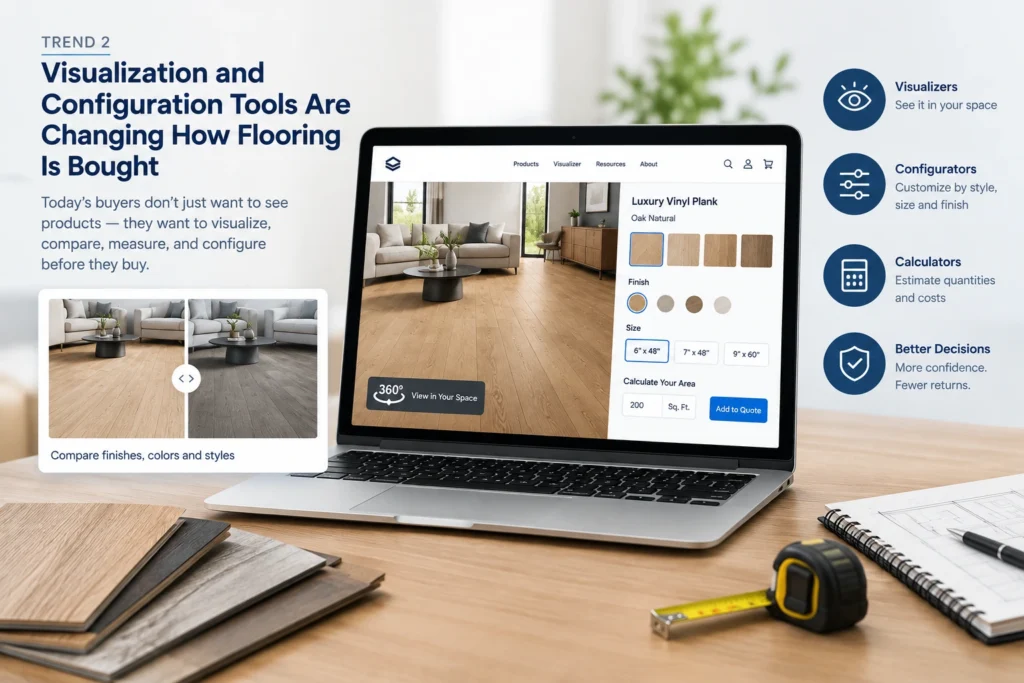
Flooring is a particularly challenging category for eCommerce because customers often want to see, compare, measure, and understand a product before committing to a purchase. A product photograph can communicate color and texture, but it cannot always answer the question that matters most to the buyer: What will this look like in my space, and is it the right choice for my project?
Digital visualization and configuration tools are helping flooring brands address that gap, and the impact shows up directly in conversion data. Shopify has reported that product listings with 3D or AR content convert at a 94% higher rate than listings without it, and other retail research points to meaningfully fewer returns once shoppers can preview a product in their own space before buying.
For tile and stone companies, this can involve room visualization and style-based product discovery. For DIY and commercial flooring buyers, the experience may instead revolve around product configurators, coverage calculations, quantity calculators, or tools that help customers determine which combination of products they need. These tools have one thing in common: they reduce uncertainty.
| Buyer type | Common digital need | Purpose |
| Homeowner | Room visualizer | Understand how a product could look in a space |
| Designer | Style and product filtering | Narrow down suitable products quickly |
| DIY buyer | Quantity calculator | Determine how much material is required |
| Contractor | Product configuration | Build an order around project requirements |
Flooring Inc introduced a custom DIY Flooring Designer to make configurable product selection easier for customers navigating a broad catalog. This illustrates an important change in flooring eCommerce: the most effective digital experiences are not simply presenting customers with more product information. They are helping customers make decisions. That distinction becomes especially important when a catalog contains hundreds or thousands of products with different sizes, colors, configurations, applications, or coverage requirements.
For tile and stone brands, the equivalent of a visualizer is often a powerful search and filtering experience. Wayne Tile Company’s rebuild added advanced cataloging so customers can locate products by SKU, collection name, shape, size, and color, backed by an Intelligent Elasticsearch implementation that improves search accuracy and automatically corrects typing errors — reducing bounce rates and helping buyers narrow a large catalog down to what actually fits their project before they ever reach a showroom.
Trend 3: Industrial and Safety Flooring Brands Are Building for B2B Self-Service
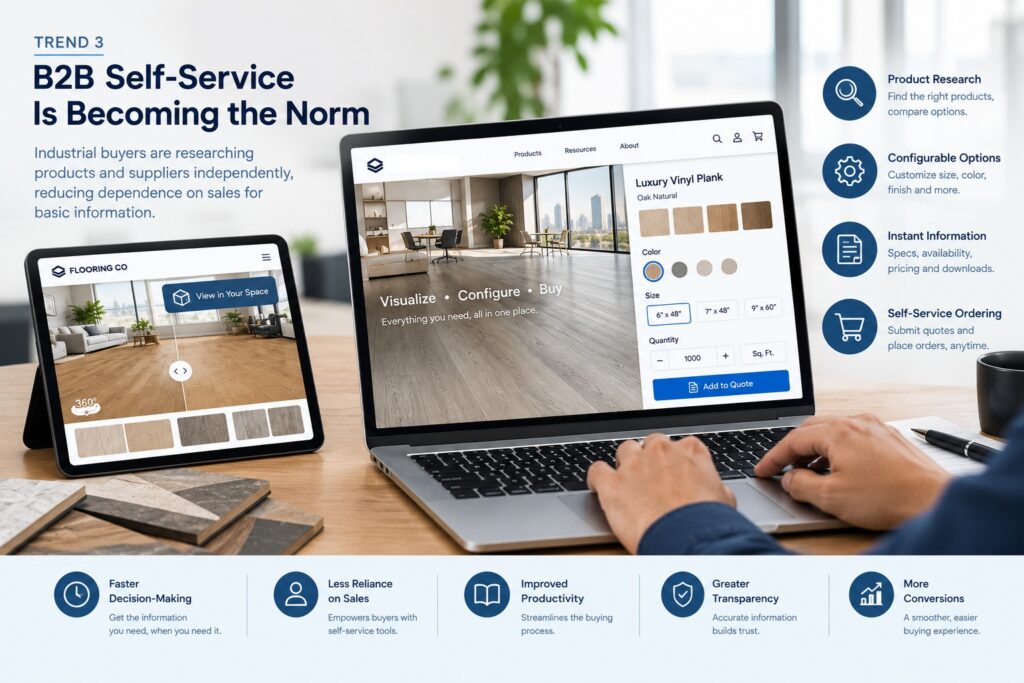
The B2B flooring buying process is becoming increasingly digital. Facilities managers, procurement teams, contractors, safety officers, and operations leaders may still rely on sales representatives for complex decisions, but they increasingly expect to conduct their initial research themselves. That means an industrial flooring website has to answer more questions before a buyer ever picks up the phone.
Gartner reported in 2026 that 67% of B2B buyers prefer a rep-free experience, highlighting the broader shift toward independent digital research. Recent buyer-behavior data reinforces just how far along that research happens before a rep ever gets involved: 6sense’s 2025 B2B Buyer Experience Report found that buyers are typically 61% of the way through their purchasing journey before making first contact with a seller, and 83% have already defined their purchase requirements by that point.
For industrial and safety flooring brands, this shift has significant implications. A buyer may not begin their search by looking for a specific product — they may begin with a problem, such as an anti-fatigue application, static control, cleanroom environment, or workplace safety requirement. The website therefore needs to organize information around applications and business problems, not just product names.
A strong industrial flooring website can give buyers access to:
● Application-based product navigation
● Industry-specific recommendations and technical specifications
● Installation and maintenance resources
● Comparison content and ROI calculators
● Certifications, patents, and distributor information
Wearwell provides a useful example. Its Adobe Commerce rebuild added a Salesforce CRM integration and custom dashboards that give sales reps and distributors direct visibility into accounts and orders, cutting down the manual back-and-forth that used to slow B2B purchasing. Wayne Tile Company took a related approach, building a dedicated B2B sales portal into its Magento platform as part of its ERP integration — giving business buyers a workflow built around how they actually purchase rather than the standard consumer storefront. This matters because industrial and B2B purchases often require more than personal preference: a buyer may need to explain and justify the purchase internally, and self-service tools that speed up ordering and give visibility into account history help them do that.
Trend 4: Educational Content Is Becoming a Core Trust and SEO Strategy
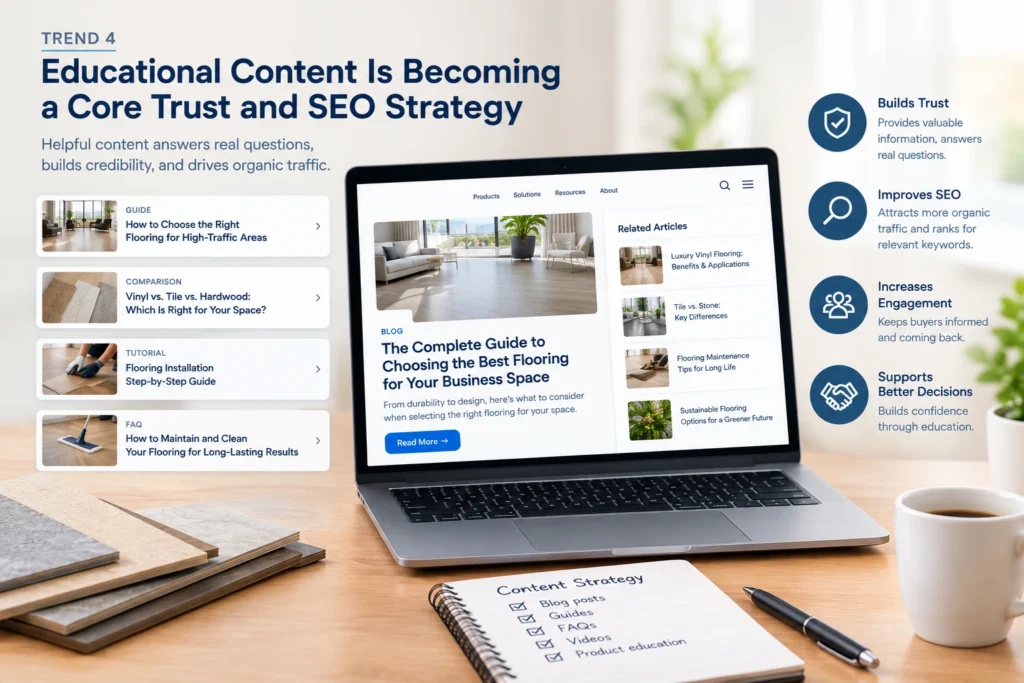
For many flooring brands, content marketing still means publishing an occasional blog article. That is no longer enough. Buyers are consuming far more content before they ever pick up the phone: a 2026 B2B buyer-behavior analysis from The SEO Works found that B2B buyers review an average of 11.4 pieces of content before they’re ready to contact a vendor. For flooring and surface brands, that content gap is either filled by the manufacturer or by a third-party review site, forum, or competitor.
Flooring and surface products often involve technical questions that buyers actively research before making a purchase, including chemical resistance, maintenance requirements, installation methods, durability, replacement schedules, safety considerations, or the differences between competing materials. These questions represent an opportunity for flooring brands to attract buyers before they have decided what to purchase or whom to purchase from. The most effective content does not simply discuss the flooring industry — it helps someone make a flooring decision.
| Content type | Example buyer question | Digital value |
| Comparison guide | Which flooring option is better for my application? | Supports product evaluation |
| Maintenance guide | How should this product be maintained? | Builds confidence after purchase |
| Installation guide | What is required to install it? | Removes implementation concerns |
| Chemical resistance guide | Will the material withstand specific chemicals? | Helps industrial buyers qualify products |
| ROI content | What will this investment save or improve? | Helps justify B2B purchases |
Content isn’t only blog posts — findability and trust signals matter just as much. Nemo Tile + Stone’s rebuild paired catalog and accessibility improvements (including ADA compliance) with better search visibility, and the result was a 45% boost in visibility and search rankings. It’s a reminder that the content and structure a site presents to search engines and buyers alike — not just the volume of blog articles published — drives how easily a brand gets found and trusted during research.
Trend 5: Backend Integration Is Becoming a Customer Experience Advantage
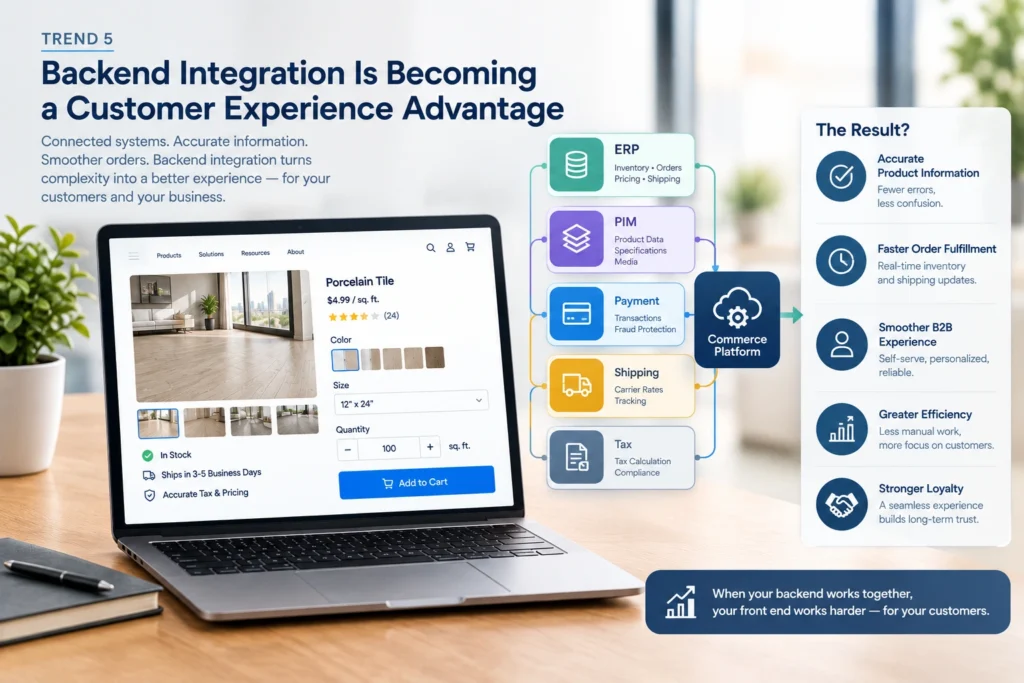
Some of the most important developments in flooring eCommerce happen where customers cannot see them. ERP systems, PIM platforms, DAM systems, tax engines, shipping services, payment providers, and eCommerce platforms all play different roles in the buying journey. When these systems work together, customers experience accurate information and smoother transactions. When they do not, the problems quickly become visible: a customer does not care whether an inventory error was caused by an ERP synchronization problem — they simply see an inaccurate availability message.
The cost of getting this wrong is high. Inventory distortion — the combined effect of stockouts, overstocks, and inaccurate records feeding a storefront — is estimated to cost global retailers $1.73 trillion annually, according to research from IHL Group. On the customer side, the damage compounds: an estimated 69% of online shoppers who hit an out-of-stock or inaccurate availability message will simply purchase from a competitor instead of waiting.
| Backend capability | Customer-facing impact |
| ERP integration: Epicor P21, Epicor Eclipse, Epicor Eagle, Epicor Bistrack, NetSuite, Acumatica | More accurate inventory, pricing, and order information |
| PIM integration: Akeneo, Pimcore, Salsify | Consistent and complete product information |
| Tax integration: Avalara, TaxJar | More accurate tax calculations |
| Shipping integration: ShipperHQ, FedEx, UPS | Reliable shipping rates and options |
| Payment integration: Worldpay, PayPal, Stripe | More flexible checkout experiences |
Flooring Inc’s platform rebuild connected NetSuite ERP, Akeneo PIM, and Canto DAM with AvaTax and a custom shipping-rate integration, plus checkout support for split payments and gift cards. Wearwell’s rebuild integrated Epicor ERP alongside Salesforce and Klaviyo, and Wayne Tile Company and Nemo Tile + Stone both connected their Epicor Prophet 21 ERP directly into their commerce platforms so that product, customer, and order data flow automatically instead of being managed by hand.
Nemo Tile’s integration delivered a concrete, measurable result: 25% faster order processing, which its team credits with improving B2B customer satisfaction. None of this exists for the sake of a sophisticated tech stack — it exists to make the customer experience more accurate and dependable. A beautiful storefront cannot compensate for inaccurate inventory or a checkout that requires manual intervention.
AI & Automation Capabilities
- AI Demand Forecasting: Predict demand patterns to support smarter inventory planning and reduce stockouts and overstocks.
- Smart Catalog: Automate product enrichment, categorization, attribute mapping, and catalog management across large product ranges.
- Dynamic Pricing: Adjust pricing based on demand, inventory levels, customer segments, and market conditions.
- AI Assistant: Help customers find products, answer questions, compare options, and move through the buying journey faster.
- Workflow Automation: Automate repetitive processes across product management, inventory, pricing, orders, and customer operations.
Ready to Improve Your B2B Commerce? Get Your B2B Commerce Assessment.
What These Trends Mean for Flooring & Surface Brands
The five trends may appear to address different areas of digital commerce, but they are all responding to the same underlying change: buyers expect the website to do more of the work. They want to find the right products, understand whether a product fits their application, compare options, visualize possibilities, and complete purchases with confidence. For B2B buyers, that expectation is even more pronounced because the digital experience often becomes part of an internal procurement process.
The result is a shift away from the traditional flooring website model:
Product catalog → Contact sales → Get information → Place order
The emerging model looks more like:
Search → Discover → Compare → Configure → Validate → Calculate → Purchase
Sales still matters. Showrooms still matter. Product expertise still matters. But the digital experience increasingly has to support the buyer through the stages that happen before those human interactions become necessary.
How DotcomWeavers Helps Flooring & Surface Brands Build for This Shift
Flooring eCommerce has its own set of challenges. Product catalogs can be large and highly configurable, customers may have very different purchasing needs, and businesses often rely on ERP and other operational systems that were not originally designed around eCommerce. DotcomWeavers approaches these projects by looking at the entire commerce ecosystem, rather than treating the website as an isolated storefront.
| Flooring business challenge | How DotcomWeavers can help |
| Multiple brand websites | Multi-brand commerce architecture and platform consolidation |
| Complex product catalogs | Product discovery, PIM integration, filtering, and structured product data |
| Difficult product selection | Configurators, calculators, and tailored UX |
| B2B purchasing complexity | Self-service commerce experiences and account workflows |
| ERP-dependent operations | ERP and eCommerce integrations |
The work is not about adding every new digital feature simply because it is available. The better approach is to identify where customers are struggling and where internal teams are losing time, then use technology to solve those specific problems. For one flooring company, that meant consolidating five websites onto Adobe Commerce.
For Wearwell, it means supporting self-directed research through application-based navigation and educational resources. For other businesses, the priority may be integrating an ERP, improving product data, or creating a better B2B purchasing experience — which is why the right digital roadmap starts with the business and its customers rather than a particular platform.
The Future of Flooring and Surface eCommerce Is More Connected, Not Just More Digital
The flooring and surface industry does not need digital innovation for its own sake. It needs digital experiences that make complicated buying decisions easier. That means consolidating unnecessary technology complexity, giving customers better ways to visualize and configure products, enabling B2B buyers to conduct more of their research independently, creating content that answers real questions, and connecting the backend systems that keep the entire experience accurate.
The brands that do these things well will not simply have better websites — they will have digital commerce operations aligned with how customers actually research and buy. If your flooring or surface brand is evaluating its next digital investment, the right starting point may not be another redesign, but a closer look at where your current experience is creating friction for customers and internal teams.
Talk to DotcomWeavers about building a flooring commerce strategy around those opportunities.