Can AI inventory forecasting really help HVAC and plumbing distributors?
Yes, when the underlying ERP and inventory data are reliable.
McKinsey reports that AI-enabled inventory planning can reduce inventory levels by 20% to 30%, but results depend on data quality, how well forecasts connect to replenishment, and each distributor’s own baseline.
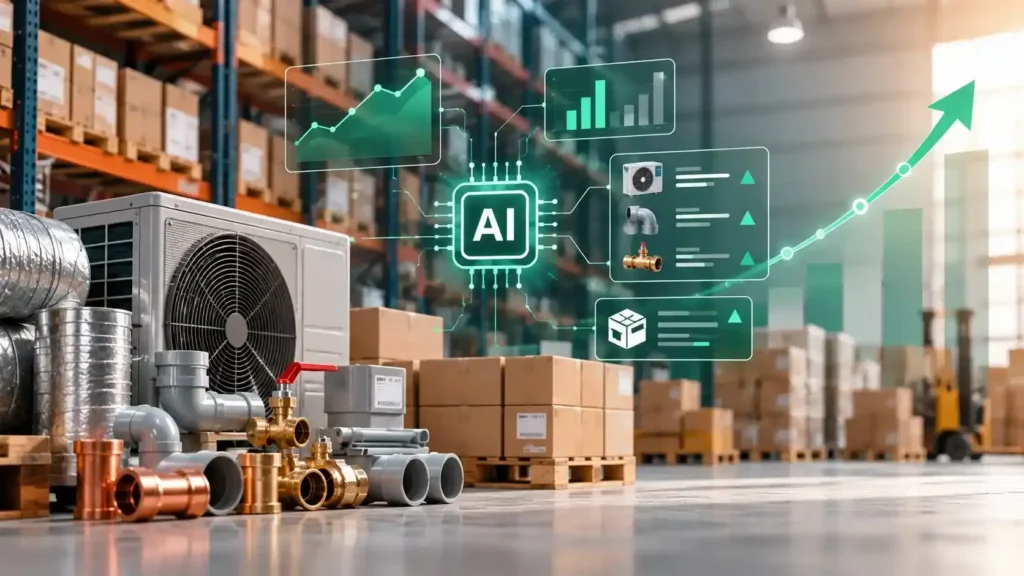
AI inventory forecasting for HVAC and plumbing distributors uses machine learning to predict what products will be needed, when they will be needed, and in what quantities. Instead of relying only on historical averages, modern forecasting can combine sales history with seasonality, inventory velocity, lead times, branch-level demand, and external signals. The goal is straightforward: carry less of the wrong inventory while having more of the right inventory when contractors need it.
Which business KPIs can AI inventory forecasting improve?
AI inventory forecasting can directly influence key distribution KPIs such as:
Better demand visibility helps distributors reduce overstock, protect product availability, improve cash flow, and make purchasing decisions with greater confidence.
For an HVAC or plumbing distributor, that distinction matters. A stockout in February is inconvenient. A stockout on a high-volume furnace component when a cold snap hits can cost the sale, the contractor relationship, and potentially the next order too.
The question is no longer whether AI can forecast demand. The better question is whether your data, ERP, inventory processes, and commerce infrastructure are ready to turn those forecasts into better purchasing decisions.
Why does manual forecasting fail HVAC and plumbing distributors every peak season?
Manual forecasting struggles because HVAC and plumbing demand is not simply seasonal. It is seasonal, regional, project-driven, contractor-driven, and heavily influenced by availability.
A distributor may see demand for cooling equipment accelerate earlier than expected because of an early heat wave. A large commercial project can suddenly consume products that normally move slowly. A discontinued equipment model can create a rush for compatible parts. Meanwhile, another branch can be sitting on excess stock of the same SKU.
Spreadsheets can report what happened. They are much less effective at telling purchasing teams what is about to happen across thousands of SKUs and multiple branches.
That creates the familiar distribution problem:
- Too much inventoryWorking capital gets trapped in slow movers.
- Too little inventoryFast-moving products disappear exactly when demand peaks.
- Inconsistent branch stockingOne location has excess while another is scrambling to transfer product.
- Planner overloadBuyers spend hours adjusting reorder points instead of managing suppliers and exceptions.
- Poor visibilityThe eCommerce storefront, ERP, and purchasing team may not be working from the same inventory picture.
The industry is already moving toward more data-driven decision-making. Phocas reported in its 2026 State of Sales in Distribution research that 49% of distributors surveyed were already using AI for sales, while 39% were not tracking sales forecasting accuracy. That second number is particularly important. You cannot improve a forecast you do not measure.
What does the performance gap look like?
A 2025 IJSRA study using HVAC, plumbing, and electrical service data compared forecasting approaches using historical work orders. Its test found a mean absolute error of 21.3 for a seasonal-average baseline versus 9.8 for gradient boosting.
That is a substantial reduction in forecast error, although the study is a specific pilot and should not be treated as a guaranteed distributor benchmark.
The lesson is less about promising a particular percentage and more about what machine learning can uncover when the underlying data is usable.
What does AI inventory forecasting do that spreadsheets cannot?
Traditional forecasting generally starts with history. AI forecasting starts with history, then looks for relationships within and around that history.
For a distributor, that can mean analyzing thousands of SKU-level demand patterns simultaneously rather than asking a buyer to manually adjust reorder points one product at a time.
The difference becomes particularly valuable in four areas.
Seasonality
AI can identify changing demand patterns instead of assuming this year’s season will behave exactly like last year’s.
Demand signals
Weather, regional activity, branch velocity, customer ordering patterns, and supplier lead times can become inputs when the necessary data is available.
SKU relationships
Products do not sell in isolation. Demand for one component can influence demand for compatible products, accessories, replacement parts or related equipment.
Dynamic inventory decisions
Instead of applying the same safety-stock logic across an entire catalog, forecasting models can help differentiate stable products from volatile products with unpredictable demand.
Better allocation of budget
This is especially relevant for large B2B catalogs. DotcomWeavers describes HVAC and plumbing distribution as a use case where seasonal demand, contractor buying patterns, and weather-driven spikes need to be considered together rather than treated as generic retail demand. (DotcomWeavers)
The important caveat is that better algorithms do not compensate for bad data. If the ERP contains inaccurate inventory, incomplete order history, or inconsistent SKU records, AI simply produces a more sophisticated version of the wrong answer.
How does manual forecasting compare with AI forecasting?

The difference is not simply “spreadsheet versus AI.” It is reactive planning versus a forecasting process that can continuously incorporate new information.
| Dimension | Manual forecasting | AI forecasting |
|---|---|---|
| Demand model | Historical averages and planner judgment | Machine-learning models trained on demand patterns |
| Seasonality | Often based on fixed seasonal indexes | Can adapt as demand patterns change |
| Branch demand | Frequently managed through manual adjustments | Can forecast at SKU and location level |
| External signals | Usually separate from the forecast | Can incorporate relevant external data |
| New SKUs | Little or no historical basis | Can use attributes and comparable products where supported |
| Safety stock | Often fixed or manually maintained | Can dynamically reflect demand and lead-time variability |
| Forecast updates | Periodic | Can continuously or regularly retrain |
| Planner workload | High manual intervention | More focus on exceptions and decisions |
| Scalability | Difficult across large catalogs | Designed to analyze large datasets simultaneously |
| Explainability | Planner knows the assumptions | Good systems should show the factors influencing the recommendation |
But better modeling alone does not create better inventory outcomes. The real value comes from how well the forecasting system fits the distributor’s operations.
When evaluating an AI forecasting tool, HVAC and plumbing distributors should look for:
- Distributor-specific forecastingCan it handle multi-branch inventory, contractor purchasing patterns, supplier lead times, and large SKU catalogs?
- Seasonal and external signalsCan it incorporate weather, construction activity, or other relevant demand drivers, and clearly show how they affect the forecast?
- New-SKU forecastingAsk what happens when a product has little or no sales history. Can the system use product attributes, comparable SKUs, or other signals?
- ERP integrationForecasting needs reliable access to sales history, inventory, branch stock, purchase orders, supplier lead times, product attributes, returns, and supersessions. For Epicor environments, integration with platforms such as Eclipse and Prophet 21 is particularly important. DotcomWeavers helps connect ERP data, inventory, pricing, and commerce workflows rather than treating the ERP as a disconnected back-office system.
- Forecast explainabilityBuyers should be able to understand why order quantities or safety-stock recommendations changed and which signals influenced them.
- Data readinessBefore implementation, audit for missing history, duplicate SKUs, inconsistent units of measure, inaccurate inventory balances, and incomplete supplier or branch-level data.
The goal is not to replace the planner. It is to give planners better signals, fewer manual calculations, and more time to act on exceptions.
That is where AI forecasting moves beyond an analytics project and becomes an operational commerce capability, connecting demand signals to replenishment, purchasing, branch allocation, and the digital buying experience.
How much does AI inventory forecasting cost for HVAC and plumbing distributors?
There is no single price because forecasting software can range from lightweight SaaS to a full supply-chain planning platform.
A practical budgeting framework looks like this:
| Investment level | Typical budget approach | Best suited for |
|---|---|---|
| Entry SaaS | Subscription plus implementation | Smaller catalogs and relatively predictable demand |
| Mid-market | Tens of thousands of dollars in Year 1, depending on integration and scope | Growing distributors with multiple branches and complex SKU demand |
| Enterprise | Six figures and potentially much more | Large networks, complex supply chains and advanced planning requirements |
| Custom | Build, data infrastructure and ongoing ML maintenance | Organizations with unusual requirements and strong internal technical teams |
Treat published vendor pricing as indicative, not as a quote. Your actual cost will depend heavily on SKU count, locations, ERP, integrations, data preparation, and required forecasting depth.
Some costs rarely appear in the headline software price:
For a B2B distributor, integration can be particularly important. Spending $40,000 on software and then discovering another six months of integration work is not a forecasting strategy. It is a project-management problem.
What ROI should an HVAC or plumbing distributor expect from AI forecasting?
The strongest business case is not “AI makes forecasting better.” It is what better forecasting does to working capital, service levels, and operational productivity.
McKinsey reports that AI-enabled inventory planning can reduce inventory levels by 20% to 30% while also improving other distribution metrics. It also cites a building-products distributor that improved fill rates by 5% to 8% points through an AI-enabled supply-chain control tower.
Your business case should therefore measure multiple ROI drivers.
| ROI driver | What to measure |
|---|---|
| Inventory reduction | Dollars released from excess stock |
| Stockout reduction | Lost sales avoided during peak demand |
| Inventory turns | Improvement in annual inventory velocity |
| Fill rate | Orders fulfilled from available stock |
| Dead stock | Reduction in obsolete or slow-moving inventory |
| Planner productivity | Hours redirected from manual forecasting |
| Emergency purchasing | Reduction in costly rush procurement |
| Customer retention | Contractor accounts retained through better availability |
Consider a distributor carrying $10 million in inventory.
That does not mean the distributor automatically earns $2 million in profit. The financial impact depends on carrying costs, cost of capital, storage, obsolescence, and what happens to the released working capital.
That distinction matters when building an executive business case.
And yes, extraordinary ROI cases exist. Nucleus Research reported a 927% ROI for Rastelli Food Group after its RELEX deployment, including $3 million recovered from aged inventory and a 95% reduction in production-planning time. But that is a specific case, not a reasonable promise for every distributor.
For an HVAC or plumbing distributor, the more credible approach is to model your own baseline.
Start with four numbers:
- Current inventory value
- Current inventory turns
- Peak-season stockout or lost-sales rate
- Annual planner hours spent on forecasting and replenishment
Then model conservative, moderate, and aggressive scenarios.
That gives your CFO something much more useful than an AI vendor’s headline ROI percentage.
How does AI forecasting work with Epicor?
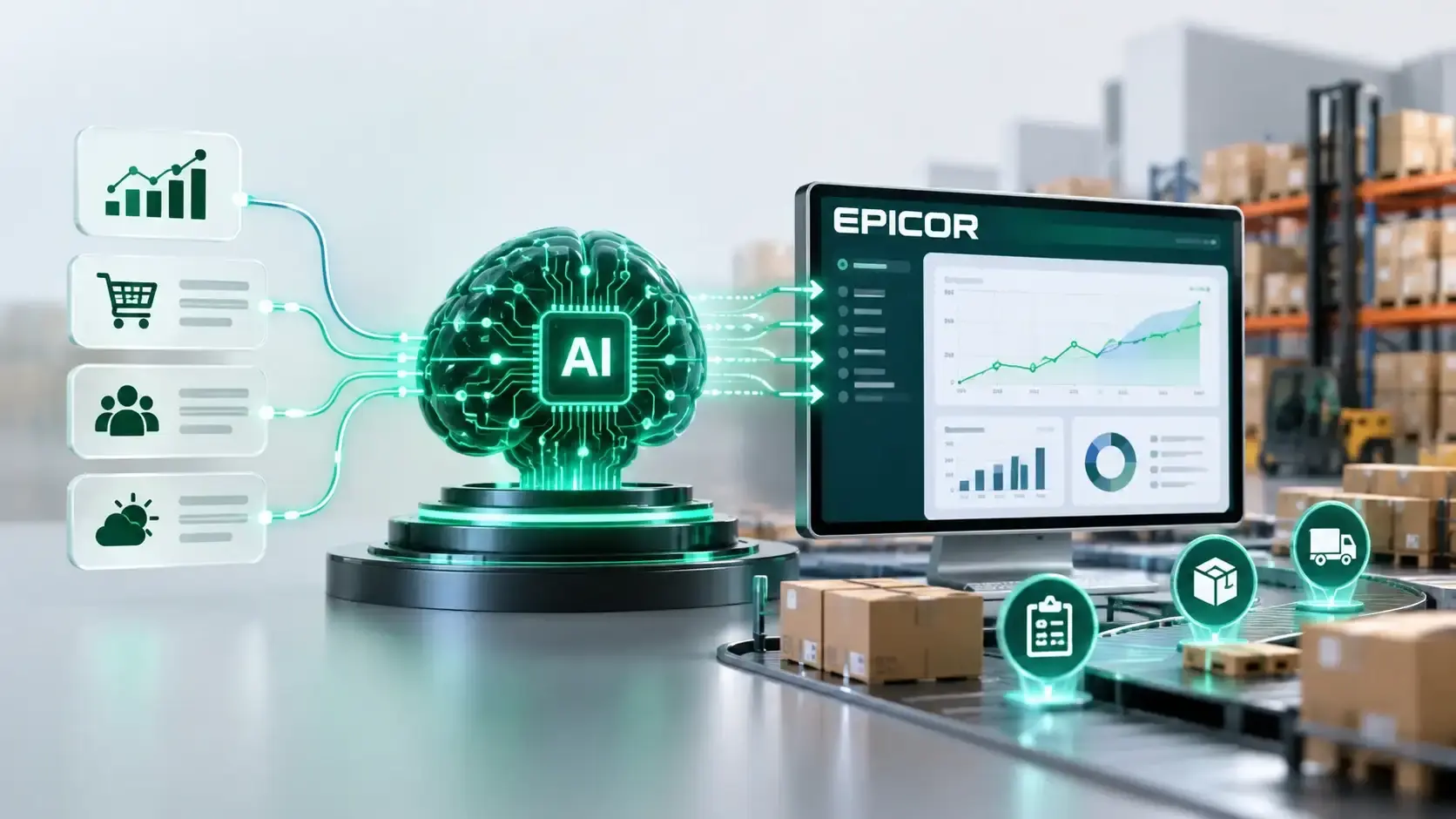
For Epicor distributors, the forecasting project should begin with the ERP, not the AI model.
Eclipse, Prophet 21, and Kinetic environments can contain years of valuable purchasing, inventory, customer, and product data. The question is whether that information is structured and accessible enough to support the forecasting workflow you want to build.
The practical sequence is:
- Audit the ERP data. Identify what is clean, what is missing, and what can actually be exposed to the forecasting platform.
- Define the forecasting level. Decide whether you need forecasts by SKU, branch, customer segment, warehouse, or some combination.
- Select the forecasting architecture. That could mean an ERP-native capability, a specialist forecasting platform, or a custom AI layer connected to the existing stack.
- Integrate forecasting with replenishment. A forecast sitting in a dashboard does not improve inventory by itself. The recommendation needs to influence purchasing and replenishment decisions.
- Run in parallel. Compare AI recommendations with current planning for several cycles before making it the operational source of truth.
DotcomWeavers specifically offers an Epicor Integration Health Check for HVAC and plumbing environments, including an assessment of contractor pricing, counter-day rates, and seasonal inventory patterns.
That is the right place to start if the ERP is the question mark.
Is your HVAC or plumbing distribution business ready for AI forecasting?
You are probably ready to investigate AI forecasting if several of these statements sound familiar:
- Peak season repeatedly creates stockouts on products you know will move.
- Buyers spend significant time manually changing reorder points.
- Slow-moving inventory keeps consuming warehouse space and working capital.
- Branches frequently transfer inventory because stock is in the wrong location.
- You have several years of usable order and inventory history.
- Your catalog is large enough that manual SKU-by-SKU optimization no longer scales.
- Your Epicor data is accessible and reasonably clean.
- Operations and purchasing leadership are willing to change how replenishment decisions are made.
But AI is not the answer to every inventory problem.
If your inventory records are unreliable, SKU data is fragmented, or your purchasing team does not trust the recommendations, fix those foundations first.
Bad data plus AI does not equal intelligent inventory.
How can DotcomWeavers help HVAC and plumbing distributors with AI forecasting?
DotcomWeavers approaches AI forecasting as part of the broader commerce and operations ecosystem, not as a standalone analytics tool.
Its current AI offering for HVAC and plumbing distributors focuses on connecting AI with existing systems such as Epicor Eclipse and Prophet 21, while also addressing catalog structure, contractor portals, order automation, and operational workflows.
That matters because the forecast ultimately needs to influence downstream operations.
If AI predicts higher demand for a product, purchasing needs to act on it. Inventory needs to update. The eCommerce experience needs accurate availability. Contractors need reliable stock information. Orders need to flow back into the ERP without manual intervention.
DotcomWeavers also positions Inventory Intelligence around connecting ERP purchase history and SKU-level velocity data to AI forecasting, with a focus on high-SKU B2B distribution environments.
The broader objective is simple: connect the data, intelligence, and commerce workflows so forecasting becomes operational, not theoretical.
What should HVAC and plumbing distributors do next?
AI inventory forecasting is not primarily a technology decision. It is a working-capital, service-level, and margin decision.
The distributors that get the most value will not necessarily be the ones that buy the most sophisticated AI platform. They will start with clean ERP data, choose forecasting models that fit their business, integrate recommendations into replenishment workflows, and give their purchasing teams enough visibility to trust the system.
For an HVAC or plumbing distributor, the opportunity is particularly compelling because demand is difficult, seasonal, and expensive to get wrong.
The goal is not to predict the future perfectly. It is to make better inventory decisions before the future arrives.
If Epicor is at the center of your operation, start with a data and integration assessment before selecting the forecasting technology. DotcomWeavers’ Epicor Integration Health Check can help identify the ERP, data, and integration gaps that need to be addressed first. From there, its AI solutions for HVAC and plumbing distributors can connect forecasting, inventory intelligence, and B2B commerce into a system built around how your business actually sells and fulfills.
Forecast earlier. Stock smarter. Give contractors fewer reasons to call your competitor.
Book an Epicor Integration Health CheckFAQs
What is AI inventory forecasting for HVAC and plumbing distributors?
AI inventory forecasting uses machine learning to analyze sales history, seasonality, inventory movement, lead times, branch-level demand, and other signals to predict future product demand. For HVAC and plumbing distributors, it helps improve replenishment decisions, reduce excess inventory, and maintain availability during peak demand.
How can AI forecasting help HVAC and plumbing distributors?
AI forecasting can help distributors reduce excess inventory, prevent stockouts, improve inventory turns, optimize safety stock, and make more accurate purchasing decisions. It can also reduce the manual workload involved in forecasting thousands of SKUs across multiple branches.
Can AI forecasting predict seasonal HVAC demand?
Yes. AI forecasting can identify seasonal patterns in HVAC demand and adjust predictions based on historical demand and other relevant signals. When integrated with external data such as weather patterns, it can also help distributors prepare for demand spikes caused by unusual temperature changes.
How much does AI inventory forecasting cost?
The cost varies based on the number of SKUs, branches, ERP system, integrations, data preparation, and forecasting capabilities required. Smaller distributors may use subscription-based SaaS tools, while larger distributors with complex ERP and supply-chain environments may require tens of thousands or six figures in implementation and technology investment.
What ROI can distributors expect from AI inventory forecasting?
ROI depends on the distributor’s starting point and how forecasting is integrated into purchasing and replenishment. Potential benefits include lower inventory carrying costs, fewer stockouts, higher inventory turns, reduced dead stock, fewer emergency purchases, and improved planner productivity. Industry results can vary significantly, so distributors should calculate ROI against their own inventory and operational baselines.