Tile, stone, matting, safety flooring. Different products, sold in completely different ways, to completely different buyers. And yet, over the past several years, working with six brands across this industry at DotcomWeavers, we kept running into the same three problems over and over: product discovery, configurability, and platform fragmentation.
We’ve built and optimized eCommerce platforms for Wayne Tiles, Nemo Tile + Stone, Whiz-Q Stone, Flooring Inc, Wearwell, and MatsOnline. Some sell through showrooms. Some sell to homeowners directly. Some sell almost entirely through industrial distributors like Uline and Grainger. On paper, they don’t look like they belong in the same conversation.
But a flooring manufacturer running five separate WordPress sites just to sell one product family has basically the same problem as an industrial matting brand trying to serve aerospace, food processing, and pharma buyers off a single SKU. Underneath the different product photos, it’s the same broken data and architecture.
This post walks through what we’ve actually learned building for these brands, with real numbers from each project, so you can see where your own site might be losing sales without realizing it.
If you’re evaluating a redesign or platform migration for your flooring or surface brand, book a free site audit with DotcomWeavers.
Table of Contents
What Makes This Industry Different for Digital Commerce
“Flooring and surface” sounds like one category, but it’s really a cluster of related businesses that behave nothing alike online: tile, natural stone, resilient/vinyl flooring, carpet, industrial matting, safety flooring. Each has its own buyer, whether that’s a homeowner, a contractor, an architect, a facilities manager, or a distributor.
Two things make this space genuinely harder than most eCommerce categories:
| Challenge | Why It Matters |
| High SKU counts with configurable variants | Size, finish, color, thickness, border pattern. Generic eCommerce templates can’t present this cleanly, so shoppers give up mid-search |
| Mixed sales channels on one site | Distributor sales, direct-to-consumer eCommerce, and showroom lead generation often need to coexist on the same domain |
There’s also a physical problem you can’t design around: you can’t feel tile texture or test how a mat cushions your feet through a screen. That’s exactly why sample requests, swatch tools, and visualizers matter more here than in almost any other eCommerce vertical. They’re doing the job a showroom floor would normally do.
Wearwell’s homepage handles this well. It splits navigation into Products, Product Type, and Industries We Serve, because a single mat like its Diamond-Plate line gets bought for completely different reasons by an aerospace plant, a food processing facility, and a pharmaceutical cleanroom. Same SKU, three different buying journeys.
This is the kind of thinking DotcomWeavers brings into every flooring and surface project: start with the buyer, then figure out how the catalog should support them, not the other way around.
The 3 Biggest Pain Points We Keep Seeing
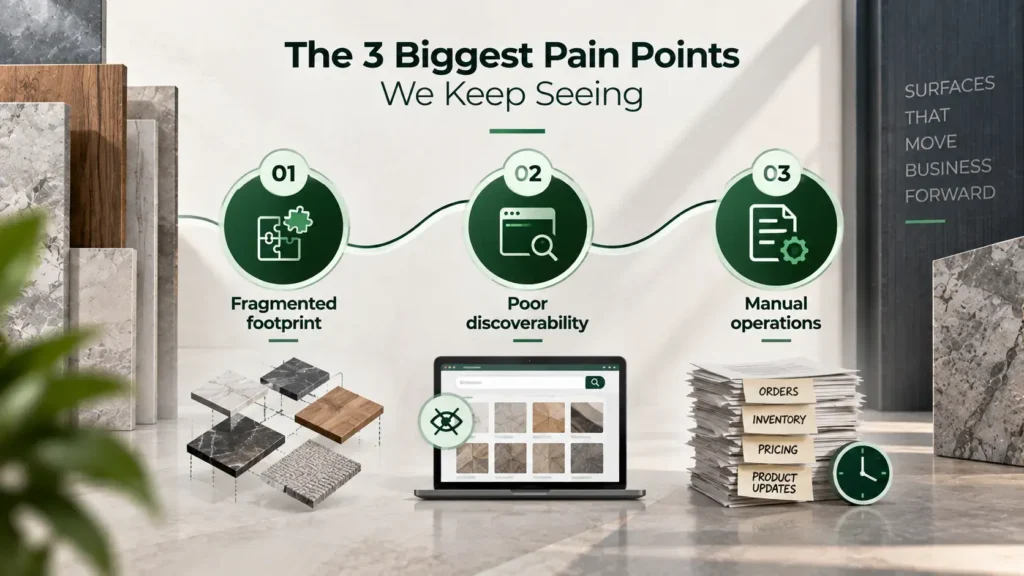
| Pain Point | Why It Happens | How DotcomWeavers Solved It |
| Fragmented digital footprint | Growth through acquisitions or new product lines leaves brands running several standalone sites | Consolidated Flooring Inc’s five separate websites into one Adobe Commerce instance |
| Poor product discoverability | Large, configurable catalogs overwhelm basic search and filtering | Rebuilt category architecture and intelligent search for Flooring Inc, Wayne Tiles, and Nemo Tile |
| Manual, disconnected operations | Orders, inventory, and tax handled outside the website, often in spreadsheets or old legacy tools. | Integrated NetSuite, Epicor Prophet 21, and Epicor Bistrack directly into the commerce platform |
- Fragmented footprint. Five separate legacy sites don’t just look messy. They mean five sets of SEO equity, five different checkout experiences, and duplicated dev costs every time something needs to change. When we consolidated Flooring Inc’s sites, protecting that scattered SEO equity took a careful process: a technical audit first, then redirect and URL mapping, then a migration of the WordPress blog into Magento with no traffic disruption.
- Poor discoverability. A configurable product, say vinyl plank in twelve colors and three thicknesses, needs real parent and child SKU logic, not a flat catalog with a filter bolted on top. Get this wrong and bounce rates on category pages climb fast, because shoppers can’t tell if the product they’re looking at even comes in the option they need.
- Manual operations. A lot of the work in flooring eCommerce happens outside the storefront entirely:
- Split payments and gift cards through Blackhawk
- Tax exemptions and multi-state logic through AvaTax
- Real-time shipping quotes through the Ship Engine API
- Live inventory sync with ERP systems like NetSuite, Prophet 21, and Bistrack
Once these gaps close, the website stops acting like an island and starts talking to the rest of the business in real time. The payoff for Flooring Inc.: consolidating five sites into one Adobe Commerce store, on a custom Hyvä frontend, produced a 37% longer engagement time just from better product discovery.
Struggling with a similar patchwork of legacy systems? Talk to the DotcomWeavers eCommerce team about a platform audit.
What We Learned Building Tile & Stone eCommerce Sites
Tile and stone buyers rarely convert on the first visit. Architects and contractors compare finish, size, and slab variation across several sessions before committing, so the site’s job is to support that longer decision cycle instead of rushing people to check out. Saved favorites, sample ordering, downloadable spec sheets, and trade account portals matter more here than a slick “buy now” button.
Across three very different tile and stone brands, we saw the same pattern show up again and again: fragmented platforms, weak ERP integration, and B2B workflows that clearly weren’t designed with a business buyer in mind.
Wayne Tiles: Two Broken Sites Become One Connected Platform
Each item gets a suggested owner — platform team, ERP admin, marketing ops, or DotcomWeavers — so nothing sits in an ambiguous “someone should handle this” state. We separate quick wins your team can act on this week from structural remediation that needs planned investment, and we don’t pad the findings to justify the fee or manufacture future work.
| The Problem | Two separate, outdated websites with no connection to their Epicor Prophet 21 ERP. Disjointed UX, inconsistent branding, manual order management |
| The Fix | Rebuilt on Magento Open Source with a mobile-first design, full Prophet 21 integration, and Intelligent Elasticsearch so shoppers could search by SKU, collection, shape, size, or color, even with typos |
| The Result | One unified catalog instead of two, with search accurate enough to cut down on dead-end product searches |
Nemo Tile + Stone: Fixing Accessibility, ERP, and B2B Experience Together
| The Problem | A WordPress site with no real eCommerce functionality, a confusing B2B experience, no ERP integration, and accessibility gaps that were quietly hurting both usability and SEO |
| The Fix | Migrated to Adobe Commerce, integrated Epicor Prophet 21, built custom B2B workflows, and brought the site up to ADA compliance |
| The Result | 35% increase in customer engagement, 45% boost in search visibility and rankings, and 25% faster order processing |
Whiz-Q Stone: Solving Nearly Every Problem at Once
Whiz-Q had one of the more layered problem lists we’ve dealt with in this industry, and most of it hit at the same time:
- Disconnected ERP and eCommerce systems
- Limited shipping and fulfillment flexibility
- Slow load times and cluttered navigation
- Manual inventory updates
- Outdated, insecure payment options
- No B2B account functionality at all
- Poor mobile optimization
- The need for a custom material calculator that could handle stone-specific measurement logic accurately
The fix was a full rebuild on Adobe Commerce: a mobile-first redesign with simplified navigation, real-time Epicor Bistrack sync, EPX, Apple Pay, Google Pay, and PayPal for checkout, Amasty Elasticsearch, Adobe Sensei product recommendations, a custom material calculator, and automated pallet deposit handling.
The result speaks for itself. Pages now load in 2.3 seconds, the material calculator became one of the most-used features on the site (which cut down pre-sales questions considerably), and the brand saw 30% more user engagement overall.
If there’s one lesson from all three of these projects, it’s that Nemo Tile’s 45% visibility jump came almost entirely from fixing accessibility and architecture, not from adding new content. That’s how much SEO value gets left on the table by technical debt alone, and how much of it a proper audit can recover.
See how DotcomWeavers approaches product discovery and lead capture for showroom-based flooring retailers. Request a UX walkthrough.
What We Learned Building Matting & Safety Flooring Sites
Matting and safety flooring is a different buyer entirely. These are B2B and industrial procurement decisions made by facilities managers, safety officers, and plant engineers, who search by application (anti-fatigue, ESD/static control, cleanroom, food processing) rather than by style or color.
Wearwell’s site structure reflects this well. Its primary navigation splits by:
- Product Type: anti-fatigue matting, ESD and static control, cleanroom, drainage, high-temp/welding, and more.
- Industries Served: aerospace, automotive, pharma, food processing, logistics, laboratories
That’s a completely different information architecture than a tile or stone site built around aesthetics, and it’s a good example of why a one-size-fits-all template just doesn’t work for this category.
Trust signals matter differently for a B2B technical buyer, too:
| Trust Signal | What Wearwell Shows |
| Longevity | Over 75 years in business, founded in 1950 |
| Innovation | 11 patents and roughly 10,000 engineered rubber compounds |
| Scale | A 240,000 sq. ft. manufacturing facility |
| Reach | Products sold in 89 countries through 6 international distribution centers |
| Channel credibility | Distributor logos from Uline, Grainger, Fastenal, and McMaster-Carr |
For a procurement professional deciding whether to request a quote, these work as commercial credibility signals, roughly the B2B equivalent of a five-star rating.
Content follows the buyer here too. Wearwell’s ROI calculator and its “Matting vs. Flooring” resource exist because an industrial buyer usually has to justify the purchase internally, to a manager or a budget line, not just decide for themselves and click buy.
MatsOnline sits in an interesting spot. It’s listed as one of Wearwell’s distributor partners, but it also runs as its own direct commercial matting retailer. That distributor-plus-retail hybrid is fairly common in industrial matting, and it’s worth designing for on purpose instead of treating it as an afterthought.
Selling technical or configurable safety products to a B2B buyer? Let’s talk about your product content and lead-gen strategy with DotcomWeavers.
What Actually Drives Conversions
| Feature | Tile/Stone (Retail/Design) | Matting/Safety (Industrial B2B) | Multi-Category eCommerce |
| Primary conversion goal | Showroom visit or quote request | RFQ or distributor purchase order | Direct online purchase |
| Key UX tool | Visual configurators, sample requests | Application and industry filters, ROI calculators | Product discovery tools, quantity calculators |
| Trust signals | Portfolio, gallery, designer partnerships | Patents, certifications, distributor logos | Reviews, warranty info, payment flexibility |
| Platform fit | Magento Open Source / Adobe Commerce | Headless or Magento with B2B account features | Full Adobe Commerce with ERP and PIM |
| SEO priority | Local and finish/material long-tail | Application and industry long-tail | Category and configurable-attribute long-tail |
Not sure which model fits your flooring or surface business? Get a free platform recommendation from DotcomWeavers.
Why Flooring & Surface Brands Choose DotcomWeavers
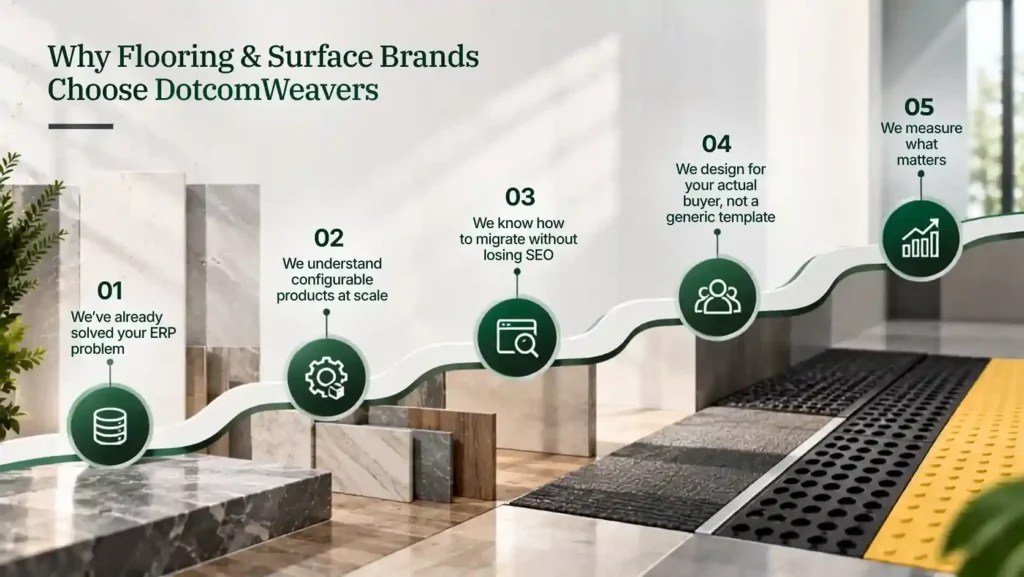
Plenty of agencies can build you a website. Far fewer have actually solved this industry’s specific problems: configurable catalogs, ERP fragmentation, B2B-plus-B2C selling, across six different brands in the same vertical. Here’s what that experience actually gets you.
- We’ve already solved your ERP problem. NetSuite, Epicor Prophet 21, Epicor Bistrack. We’ve connected all three to flooring and surface catalogs in production, so integration isn’t guesswork on your project.
- We understand configurable products at scale. Parent and child SKU architecture, faceted search, and material calculators aren’t features we bolt on after launch. They’re part of the plan from day one.
- We know how to migrate without losing SEO. Consolidating five sites into one for Flooring Inc, or fixing accessibility issues to unlock a 45% visibility lift for Nemo Tile, both came from the same disciplined, audit-first process.
- We design for your actual buyer, not a generic template. Showroom lead generation, B2B procurement, and direct eCommerce all need different information architecture, and we’ve built for all three.
- We measure what matters. Every project on this list shipped with a real, trackable result: 37% longer engagement, 35% more engagement, 45% more visibility, 25% faster order processing, 30% more engagement, and 2.3-second load times. These aren’t vanity metrics. They’re commercial ones.
Our Process for Flooring & Surface Brand Websites
The process doesn’t really change by category. What changes is how much weight each step carries for your specific business.
- Technical and SEO audit. We identify legacy risks and dependencies before touching any code. This is where we mapped SEO equity across Flooring Inc’s five original sites before consolidation.
- UX strategy. We build mobile-first, conversion-focused wireframes tailored to the buyer, whether that’s a homeowner, a contractor, or a procurement team.
- Collaborative development. Phased builds with client stakeholders reviewing progress at each milestone, not just at launch.
- SEO-conscious migration. Careful redirect mapping and content migration, including moving a WordPress blog into Magento without losing SEO.
- Integration-led automation. Connecting ERP, PIM, DAM, tax, and shipping systems so the website works with the rest of the business instead of around it.
- AI fitness assessment
- B2B maturity assessment
- Audit
Kurt Leitinger, co-founder of FlooringInc.com, said the NetSuite and Adobe Commerce integration “built a strong foundation for scalable growth.” That’s really the point of this whole process. Not just a better-looking site, but infrastructure that holds up as the catalog and the business keep growing.
This is the exact five-phase process we used to consolidate Flooring Inc’s five sites into one high-performing store. Schedule a discovery call to map your own migration plan.
Flooring and Surface Industry Trends to Watch in 2026
This industry, like any other, is changing very fast. To protect your eCommerce business, you need to check 5 trends reshaping the floors and surfaces industry.
- Unified commerce for multi-brand portfolios: Flooring businesses are consolidating brands, catalogs, and customer journeys onto scalable commerce platforms. 71% of B2B companies now offer e-commerce, with roughly one-third of their revenue flowing through digital channels.
- Visualizers are becoming essential: As buyers expect to see products in context before purchasing, room visualizers and 3D tools are becoming valuable digital alternatives to showroom sampling. 22% of homeowners say they struggle to visualize the finished result of a renovation.
- B2B self-service is becoming the norm: Contractors and procurement teams increasingly expect to check pricing, inventory, orders, and reorders without relying on sales reps. 67% of B2B buyers prefer a rep-free experience, while 70% prefer completely digital, self-service buying.
- AI is moving into catalog and pricing operations: For large flooring catalogs, AI is moving beyond search and content into pricing, product intelligence, and merchandising. 65%–85% of organizations expect to adopt generative or agentic AI for pricing within the next 1–3 years.
- B2B and B2C journeys are converging: Contractors and homeowners increasingly expect the same fast, intuitive digital experience, even when their pricing, products, and purchasing needs differ. Buyers now use an average of 10 channels throughout the B2B purchasing journey.
What makes flooring and surface company websites different from typical eCommerce sites?
They have to handle highly configurable products (size, finish, color, material) at scale, support both B2B distributor and direct consumer buyers, and provide sampling or visualization tools since customers can’t physically touch the product before buying.
Should a flooring company use Shopify, BigCommerce, or Adobe Commerce (Magento)?
It depends on how complex your catalog is and what you need to integrate with. High-SKU, configurable catalogs that need ERP and PIM integration, like Flooring Inc’s NetSuite and Akeneo setup, or Wayne Tiles’ and Nemo Tile’s Epicor Prophet 21 integrations, usually call for Adobe Commerce or Magento Open Source. Smaller, less configurable catalogs can do well on Shopify Plus or BigCommerce.
How do industrial matting and safety flooring companies market themselves online differently from tile or stone brands?
Matting and safety flooring buyers are usually B2B procurement or safety professionals searching by application, like anti-fatigue, ESD, or cleanroom, rather than by style. That calls for application-based navigation, technical spec sheets, and trust signals like patents and certifications instead of design galleries.
What’s the biggest technical challenge in flooring eCommerce?
Managing configurable product variants- color, size, thickness, finish- across a large catalog while keeping product discovery fast and accurate. That usually means a real ERP or PIM connection and custom search and filtering, not out-of-the-box eCommerce search.
Can multiple flooring brand websites be consolidated without losing SEO rankings?
Yes, as long as you do a proper technical and SEO audit, map your redirects, and run a phased migration plan. Flooring Inc consolidated five separate websites into one Adobe Commerce platform through exactly that kind of migration, and it avoided any real traffic loss.