
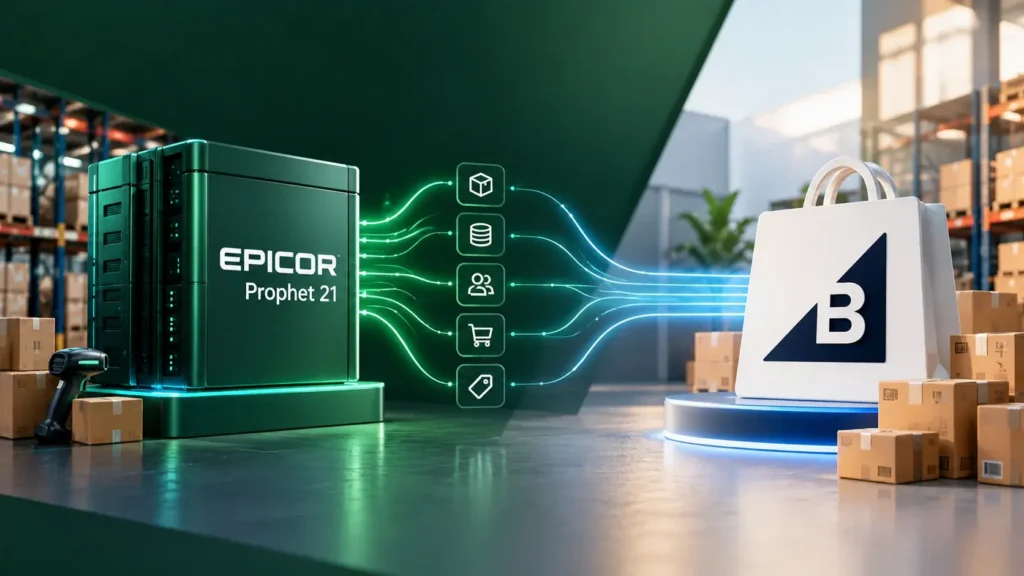
For B2B distributors, ecommerce is no longer a separate channel sitting alongside the ERP. It is becoming an extension of the business’s core operations.
Customers expect to log in, see their account-specific pricing, check product availability, place orders, request quotes, select shipping options, and track fulfillment—all without calling a sales representative.
Behind that experience, however, the ERP still needs to manage customers, inventory, pricing, orders, warehouses, and fulfillment.
That’s where Epicor Prophet 21 + BigCommerce integration becomes critical. A well-designed architecture connects BigCommerce’s B2B commerce capabilities with Prophet 21’s ERP data and business logic while allowing each platform to focus on what it does best.
At a Glance
| Business Need | Primary System | Integration Role |
|---|---|---|
| Product discovery & storefront | BigCommerce | Customer-facing experience |
| Customer accounts | Prophet 21 + BigCommerce | Sync and validation |
| Pricing | Prophet 21 | Source of pricing rules |
| Inventory | Prophet 21 | Availability data |
| Orders | BigCommerce → P21 | Validation and transaction creation |
| Fulfillment | Prophet 21 → BigCommerce | Status, shipment & tracking |
| Product enrichment | PIM | Content, images & specifications |
| Data orchestration | Integration layer | Transformation, validation & synchronization |
The goal isn’t simply to connect these systems. It is to create a commerce ecosystem where each platform plays the role it is best suited for—and where critical business data moves reliably between them.
“The goal isn’t to connect Prophet 21 and BigCommerce. The goal is to make them work as one commerce ecosystem, where pricing, inventory, orders, and customer data move with the accuracy and speed the business demands.”
What Does a Prophet 21 + BigCommerce Architecture Look Like?
A Prophet 21 and BigCommerce integration architecture defines how information moves between the ERP, ecommerce platform, and other systems supporting the digital commerce experience.
BigCommerce serves as the customer-facing commerce layer, managing product discovery, storefront experiences, customer accounts, carts and checkout, and B2B purchasing workflows.
Prophet 21 remains the operational backbone, managing customers, pricing, inventory, sales orders, invoices, payment terms, and fulfillment.
The integration or middleware layer sits between the two platforms and is the only path between them—it handles communication, transformation, validation, authentication, error handling, and synchronization. BigCommerce and Prophet 21 never connect to each other directly; every request and update passes through the Integration Layer.
Product Content
Other Systems
/ Middleware
B2B Commerce
ERP / Source of Truth
The architecture can also include a warehouse management system, tax engine, shipping platform, payment provider, marketplace, or custom applications—each connecting only to the Integration Layer, never directly to BigCommerce or Prophet 21. Instead of building separate point-to-point connections between every system, the integration layer provides a single, scalable hub that orchestrates all data flows.
Why Architecture Matters for B2B Distributors
B2B distribution is rarely as simple as standard B2C ecommerce. The same product may have different prices for different customers. Inventory may vary by warehouse. Product visibility may depend on an account or ship-to location. Buyers may use purchase orders, request quotes, or regularly reorder products.
| Requirement | Typical B2C | B2B Distribution |
|---|---|---|
| Standard pricing | ✓ | Sometimes |
| Customer-specific pricing | — | ✓ |
| Contract pricing | — | ✓ |
| Multi-warehouse inventory | Limited | ✓ |
| Purchase orders | Limited | ✓ |
| Quotes | Limited | ✓ |
| Account-specific catalogs | Limited | ✓ |
| ERP-driven workflows | Limited | ✓ |
| Reordering | ✓ | ✓ |
These requirements create dependencies between ecommerce and ERP data. That’s why the architecture needs to be designed around business processes—not simply individual data fields.
The Role of Each System
Prophet 21: The Operational Source of Truth
One of the most important architectural decisions is establishing which system owns which data.
- Customer accounts
- Pricing
- Inventory
- Sales orders
- Invoices
- Payment terms
- Fulfillment information
| Data | Source of Truth | Customer Experience |
|---|---|---|
| Customer account | Prophet 21 | Account access |
| Pricing | Prophet 21 | Personalized prices |
| Inventory | Prophet 21 | Availability |
| Orders | Prophet 21 | Order history/status |
| Product content | PIM / ERP | Product pages |
| Checkout | BigCommerce | Buying experience |
This distinction helps prevent data conflicts. If customer pricing is independently maintained in both systems, even a small discrepancy can result in incorrect prices at checkout.
Epicor has also continued expanding Prophet 21’s API capabilities, including Bulk Data APIs and pricing export automation in its 2026.1 release. These capabilities make API-driven integration increasingly relevant for distributors modernizing their commerce architecture.
BigCommerce: The B2B Commerce Layer
While Prophet 21 manages operational data, BigCommerce provides the digital buying experience.
- Customer accounts
- Company structures
- Product search
- Shopping lists
- Quotes
- Purchase orders
- Checkout
- Order history
- Reordering
BigCommerce B2B Edition also provides APIs that allow businesses to build and customize these experiences around existing systems and workflows.
For particularly complex requirements, a headless BigCommerce implementation can provide additional flexibility. However, the decision between traditional and headless architecture should be based on actual business requirements—not technology preference alone.
The Integration Layer: Where Everything Connects
The integration layer connects the platforms without making them dependent on each other’s internal architecture.
| Function | What It Does |
|---|---|
| API communication | Moves data between systems |
| Data transformation | Converts data into the format each system needs |
| Validation | Checks data before transactions are processed |
| Authentication | Secures system communication |
| Error handling | Captures and manages failed transactions |
| Retry logic | Attempts recoverable transactions again |
| Monitoring | Tracks synchronization and system health |
| Orchestration | Coordinates multi-system workflows |
What Should You Integrate?
1. Product Data
Prophet 21 may contain operational product information such as SKUs, product names, units of measure, availability, and inventory. Distributors often need richer ecommerce content.
- Product descriptions
- Technical specifications
- Images
- Documents
- Merchandising information
P21 → Operational product data
PIM → Enriched product content
BigCommerce → Customer-facing product experience
2. B2B Pricing
Pricing is often one of the most challenging parts of the integration. Distributors may have customer-specific price lists, contract pricing, quantity breaks, branch-level pricing, product-specific agreements, and other business rules.
| Pricing Requirement | Potential Approach |
|---|---|
| Relatively stable pricing | Scheduled synchronization |
| Frequently changing pricing | More frequent/API-driven updates |
| Highly dynamic pricing | Real-time pricing |
| Mixed requirements | Hybrid model |
3. Multi-Warehouse Inventory
Inventory can be just as complex as pricing. A distributor may have products across multiple warehouses or branches, and availability may depend on customer location, fulfillment preferences, warehouse, available-to-promise rules, or inventory thresholds.
| Requirement | Possible Approach |
|---|---|
| Fast-moving products | Near-real-time |
| Warehouse-specific availability | API-driven |
| Slower-moving products | Scheduled sync |
| Large catalog updates | Bulk/incremental sync |
| Inventory thresholds | Business-rule driven |
Not every inventory update needs to happen in real time. The goal isn’t to make everything instantaneous. It’s to make the right information available at the right time.
4. Orders & Fulfillment
Order integration typically begins in BigCommerce and ends in Prophet 21.
Once the ERP processes the order, relevant information can flow back to BigCommerce, including order status, shipment information, tracking numbers, backorders, invoices, and partial fulfillment updates.
Real-Time vs. Batch Integration: What Should Move When?
One of the biggest architectural decisions is determining which information needs to move in real time and which can be synchronized asynchronously.
| Data Flow | Typical Approach | Why |
|---|---|---|
| Customer validation | Real-time | Prevent invalid transactions |
| Customer-specific pricing | Real-time / hybrid | Pricing accuracy |
| Inventory availability | Real-time / near-real-time | Avoid stale availability |
| Order submission | Real-time | Transaction-critical |
| Large product catalog | Batch / bulk | Reduce API load |
| Product images | Scheduled | Usually doesn’t require real-time updates |
| Historical data | Batch | Large data volumes |
| Bulk product updates | Batch / incremental | More efficient |
Modern architectures can combine APIs, webhooks, queues, incremental synchronization, and bulk operations. The right combination depends on the business requirement.
Design for Failure, Not Just the Happy Path
A production integration needs to assume that something will eventually fail. APIs can become unavailable. Data can fail validation. Customer records can be incomplete. Orders can contain information Prophet 21 cannot process.
Security Considerations

Security should be part of the architecture from the beginning.
- Secure API authentication
- Encrypted communication
- Controlled permissions
- Secrets management
- Least-privilege access
- Logging and audit trails
For distributors handling sensitive customer, pricing, payment, and order information, security cannot be an afterthought.
Build for the Next Integration, Not Just the Next Launch
A commerce architecture should support more than today’s requirements. A distributor may eventually add another warehouse, launch a marketplace, connect a PIM, replace a shipping provider, launch another storefront, add new business applications, or introduce AI-powered search or purchasing experiences.
| Basic Integration | Scalable Architecture |
|---|---|
| Solves today’s connection | Supports future systems |
| Point-to-point connections | Modular integration layer |
| Limited error handling | Resilient workflows |
| Data synchronization focused | Business-process focused |
| Harder to extend | Easier to evolve |
| Built around current needs | Built around the technology roadmap |
How DotcomWeavers Helps
DotcomWeavers helps B2B distributors design and implement BigCommerce commerce ecosystems connected to Epicor Prophet 21 and other business-critical systems.
Our approach goes beyond basic data synchronization. We work around distributor-specific requirements such as:
- Customer-specific pricing
- Multi-warehouse inventory
- ERP-driven onboarding
- Order workflows
- Account structures
- Custom B2B experiences
Depending on the project, this can include BigCommerce B2B implementation, P21 integration, API and middleware architecture, pricing and inventory synchronization, custom applications, and PIM, CRM, shipping, and tax integrations.
Case Study: Crawford Packaging
Crawford Packaging, a multi-location packaging distributor, needed to transform its content-only website into a fully operational B2B ecommerce platform.
DotcomWeavers rebuilt the experience on BigCommerce B2B Edition and integrated it with Epicor Prophet 21.
- Location-aware catalog logic
- Location-aware pricing
- Location-aware inventory
- Customer-specific experiences
- PO-based checkout
- ERP-driven workflows
The project demonstrates why P21 integration needs to account for business rules at the architecture level rather than treating pricing, inventory, customer identity, and fulfillment as isolated features.
“DCW went above and beyond to help us navigate a complex BigCommerce implementation and successfully launch our store. Their commitment, problem-solving mindset, and focus on long-term partnership made all the difference.”
Final Thoughts
Epicor Prophet 21 and BigCommerce can provide a powerful foundation for B2B digital commerce, but the quality of the integration ultimately depends on the architecture connecting them.
Prophet 21 can remain the operational source of truth while BigCommerce delivers the customer-facing commerce experience. The integration layer connects the two while coordinating data with other systems across the distributor’s technology ecosystem.
The most effective architecture balances real-time requirements with asynchronous processing, preserves ERP business logic, accounts for complex pricing and inventory, and builds resilience into the system from the start.
For distributors planning a new BigCommerce implementation or modernizing an existing ecommerce prophet 21 integration, the goal shouldn’t simply be to connect two platforms. It should be to build a scalable digital commerce architecture that supports the business today—and continues to evolve with it.
Frequently Asked Questions
What is a Prophet 21 and BigCommerce integration?
It is an architecture that connects BigCommerce’s customer-facing B2B commerce capabilities with Epicor Prophet 21’s ERP data and business processes. An integration or middleware layer manages communication, data transformation, validation, and synchronization between the systems.
Which system should be the source of truth?
For most distributors, Prophet 21 should remain the source of truth for operational data such as customers, pricing, inventory, orders, invoices, and fulfillment. BigCommerce should use that information to power the customer-facing commerce experience.
Can BigCommerce support customer-specific P21 pricing?
Yes. The architecture can synchronize relatively stable pricing or retrieve pricing information dynamically, depending on how complex and frequently changing the distributor’s pricing rules are.
Does inventory need to sync in real time?
Not necessarily. Fast-moving or transaction-critical inventory may benefit from real-time or near-real-time updates, while slower-moving inventory and large catalog updates can often use scheduled or incremental synchronization.
Can Prophet 21 integrate with a PIM and BigCommerce?
Yes. A modular integration architecture can allow Prophet 21 to provide operational product information, a PIM to manage enriched product content, and BigCommerce to deliver the customer-facing product experience.
What happens if an integration transaction fails?
A resilient architecture should include transaction logging, retries, exception handling, monitoring, and safeguards against duplicate transactions. This helps determine whether a failed or timed-out transaction was actually processed before attempting it again.
Is headless BigCommerce necessary for P21 integration?
Not always. Headless architecture can provide additional flexibility for businesses with complex requirements, but the decision should be based on actual business needs rather than technology preference.
How can distributors prepare their architecture for future growth?
A modular integration layer makes it easier to add systems such as new warehouses, marketplaces, PIMs, shipping providers, storefronts, and other applications without rebuilding the entire commerce ecosystem.