
ECC isn’t broken. It’s just becoming your most expensive competitive disadvantage. Industrial distributors are living in a split-brain reality right now. On one side, your buyers are arriving with modern expectations: self-service portals, real-time pricing, one-click reordering, and instant visibility into multi-warehouse stock. On the other side, you’re running a commerce platform that was built for an older digital era — one where “good enough” meant a working catalog and a checkout button.
Epicor Commerce Connect (ECC) delivered real value for a long time, and for most distributors, it still functions. That’s actually the problem. Because ECC works, the urgency to change it feels abstract — until a competitor launches a better buying experience, or a major account starts asking about punchout integrations your platform can’t support.
Here’s the timeline reality: ECC is moving cloud-first. Final on-premises releases are rolling out through 2026–2028, with sustaining support potentially transitioning as early as 2027. This isn’t a distant roadmap item. The window to migrate on your terms — rather than under pressure — is closing.
At DotcomWeavers, we’ve guided 20+ Epicor clients through exactly this transition — across Prophet 21, Eclipse, and Kinetic environments, across Adobe Commerce, BigCommerce, and Shopify Plus. This blog is the framework we use internally: not a “should you migrate?” post, but a step-by-step guide for how industrial distributors migrate — built around the specific complexities of your industry.
Let’s get into it.
Why ECC Migration Hits Differently for Industrial Distributors

Every eCommerce migration is hard. ECC migrations for industrial distributors are a different category of hard — and any partner or consultant who tells you otherwise hasn’t done one.
The ECC-ERP Dependency: A Feature That Became a Liability
ECC’s original value proposition was tight: native integration with Prophet 21, Eclipse, and Kinetic meant pricing rules, customer accounts, and inventory sync all lived in one system. No middleware headaches, no sync lag, no conflicting records. For distributors managing thousands of customers and complex negotiated pricing, that was genuinely valuable.
But that same tight coupling is now the ceiling on your digital roadmap. When your eCommerce architecture is governed by your ERP schema, innovation gets throttled at the source. New channels — marketplaces, mobile apps, buyer portals — don’t fit ECC’s integration model cleanly. AI-driven personalization requires data and platform flexibility that ECC wasn’t designed to expose. Punchout integrations for procurement platforms like Ariba, Coupa, and SAP need an API surface that ECC’s architecture simply doesn’t provide in the way modern buyers expect.
The dependency that made ECC valuable is now the constraint that’s slowing your growth.
One thing worth emphasizing here: moving off ECC does not mean moving off Epicor. Your ERP stays. What changes is the eCommerce layer sitting in front of it — and how that layer connects back. DotcomWeavers specializes in exactly this: preserving and rebuilding the Epicor integration on a modern platform so that distributors get a new front-end without disrupting the ERP workflows their operations depend on.
The Cost of Waiting Compounds
Every quarter your team stays on ECC, the gap widens in two directions. First, the gap between your digital experience and what your buyers have come to expect from best-in-class B2B portals. Second, the gap between the AI-native features now standard on modern platforms and the structural limitations of ECC’s architecture.
Intelligent search that understands part numbers and interchange data. Predictive reorder recommendations. Agentic procurement tools that let buyer-side AI submit POs autonomously within approval rules. None of these are ECC roadmap items — they’re standard or near-standard features on Adobe Commerce, BigCommerce, and Shopify Plus today.
And migration cost increases over time, not decreases. More customizations accumulate. Data gets messier. Fewer developers know ECC’s architecture. The “later” option gets more expensive every quarter you delay it.
74% of B2B buyers now prefer digital purchasing channels. 97% say fast, accurate online purchasing is essential to their business. (Distribution Strategy Group, 2025)
The 2026 Migration Framework — 7 Phases for Industrial Distributors
Most migration frameworks are too vague to be useful. “Assess. Plan. Execute.” covers everything and guides nothing. What follows is the phase-by-phase framework DotcomWeavers uses for industrial distributors migrating off ECC — with the hard parts named explicitly.
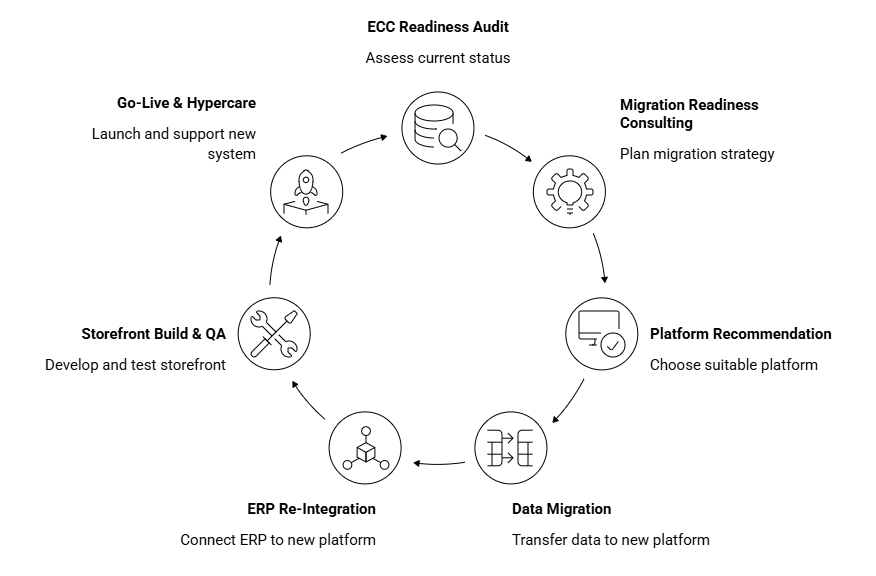
Phase 1 — ECC Readiness Audit
We assess your current setup, data, and integrations to build a clear, realistic migration plan before a single line of code moves.
This is the phase most teams rush — and the one that determines whether everything downstream goes smoothly or sideways. Before evaluating platforms or scoping a build, you need an honest picture of what you’re actually migrating from.
DotcomWeavers’ readiness audit covers four areas:
Data quality. Product catalog completeness, duplicate SKUs, orphaned records, customer account inconsistencies, and historical order accuracy. This single assessment shapes your data migration scope more than anything else.
Integration inventory. Every ERP connection currently running through ECC, which are native modules, custom-built, and whether documentation exists for either. The answer determines whether you’re rebuilding from scratch or adapting an existing pattern.
Customization log. ECC implementations accumulate customizations over time — some load-bearing, some legacy patches nobody wants to touch. Separating them before platform selection prevents costly surprises mid-build.
Team readiness. Who owns this migration? Is IT aligned with eCommerce and sales? Who has final decision authority? Migrations stall when this is unclear at the start.
Key output: A migration risk scorecard ranking complexity across data, integrations, and customizations — so your leadership team has an honest view of scope before any commitments are made.
Start with a DotcomWeavers ECC Migration Assessment →
Phase 2 — Migration Readiness Consulting
Before the build begins, distributors need a clear migration strategy — not just a platform pick and a project plan.
This is where DotcomWeavers works through the decisions that will shape every phase that follows: What does the integration architecture need to look like on the new platform? Which ECC customizations get rebuilt, which get retired, and which get rethought? What’s the right data cutoff for order history migration? How do you sequence the work so ERP operations are never at risk?
Most of these decisions have no universally correct answer — they depend on your buyer base, your operations team, and your ERP configuration. Getting them right before the build starts is what separates migrations that land on time from ones that expand indefinitely.
Phase 3 — Platform Recommendation
This is where many distributors make a costly mistake: letting a platform vendor or a generalist agency drive the decision based on their partnership margins rather than your operational reality.
DotcomWeavers is platform-agnostic. We are certified across Adobe Commerce, BigCommerce, and Shopify Plus — and we recommend based on your profile, not our preferences. Here’s how the selection logic typically plays out:
| Your Situation | Platform to Consider |
| Enterprise-scale, complex catalog, deep CPQ needs | Adobe Commerce |
| Mid-market, strong native B2B tools, SaaS preferred | BigCommerce |
| SMB to mid-market, fastest go-live is the priority | Shopify Plus |
| Mid-market, full platform control, strong in-house tech team | Magento Open Source |
Beyond the general profile, industrial distributors need to pressure-test platforms against criteria that don’t show up in standard reviews:
- Native B2B pricing tier support — not just price lists, but actual customer-specific pricing rules and contract terms that sync live from your ERP.
- ERP connector depth for your specific Epicor flavor. Eclipse, Prophet 21, and Kinetic have different data models and API architectures. A connector that works for P21 doesn’t automatically work for Eclipse. DotcomWeavers verifies connector depth — not just connector existence — before any platform recommendation is finalized.
- Punchout and EDI readiness for procurement-connected buyers on Ariba, Coupa, or SAP.
- Agentic commerce compatibility — can the platform’s API surface support autonomous reorder agents and AI-assisted procurement workflows in the next 12–18 months? This is a 2026 evaluation criterion that didn’t exist two years ago.
For a full side-by-side breakdown, see our ECC Migration Matrix.
Phase 4 — Data Migration
The most underestimated phase in almost every ECC migration. Teams budget for the export. They underestimate the transformation, validation, and re-import cycles that make the data actually work on the new platform.
Industrial distributors carry decades of product data, customer pricing records, and order history — often inconsistently structured across ERP versions and prior platform builds. Moving it cleanly is not a one-time export. It is a disciplined, multi-run process.
- Products. Normalize attribute data before migration. Map ERP product fields to the new platform’s taxonomy. A 500,000 SKU catalog with inconsistent attribute structures creates a broken search experience on any modern platform — clean it before it moves, not after.
- Customers. Deduplicate records. Validate account hierarchies so parent/child relationships map correctly to the new platform’s B2B structure. Confirm pricing tier assignments survive the transition intact.
- Order history. Set your historical cutoff before migration begins — full history vs. last 24 months is a scope and QA decision, not a default. DotcomWeavers recommends 24 months as the starting point, adjusted by how actively your buyers reference older order data.
- Pricing. Contract pricing and customer-specific rules must be rebuilt in the new platform’s B2B pricing engine. This is consistently the most complex data migration task for industrial distributors — and the one most likely to expand the timeline if underestimated.
Phase 5 — ERP Re-Integration
Your Epicor ERP is not going anywhere. What changes is how your new eCommerce platform connects to it — and this phase is where the migration holds together or falls apart.
ECC’s native integration was tightly coupled to Epicor’s internal data model by design. A new platform integration is rebuilt using APIs or middleware — Celigo, Alumio, or a custom connector, depending on your environment. This is a rebuild, not a copy-and-paste, and it should not replicate ECC’s architecture. It should improve on it.
What the integration must cover for industrial distributors:
- Real-time inventory sync across warehouses and branches. Will-call buyers and multi-location distributors cannot operate on batch data.
- Bi-directional order sync — web orders to the ERP for fulfillment, and ERP-originated orders (phone, EDI, sales rep) visible in the customer portal for tracking and reorder.
- Customer account and pricing sync — changes made in the ERP are reflected in the portal in real time, without manual intervention.
- RMA and return flows — consistently deprioritized in migration scoping, consistently painful when they’re not mapped before go-live.
A critical nuance: Eclipse, Prophet 21, Kinetic, BisTrack, and Eagle have meaningfully different integration architectures. DotcomWeavers has live integrations running across all three, which means our rebuild strategy comes from production experience, not first-principles guesswork. See our Epicor Eclipse and Prophet 21 integration pages for specifics.
Phase 6 — Storefront Build & QA
The storefront build is scoped and executed against the B2B requirements surfaced in the readiness and consulting phases — account hierarchies, approval workflows, punchout integrations, and customer-specific pricing displays built in from the start, not retrofitted after launch.
QA for B2B eCommerce goes beyond standard eCommerce testing. The checklist DotcomWeavers runs includes pricing validation against actual customer accounts, purchase order checkout flows, account hierarchy access testing across parent and child accounts, and punchout integration testing with your top procurement-connected buyers. These are the failure points that generic QA scripts miss — and the ones that cause the most friction with industrial buyers when they surface post-launch.
Phase 7 — Go-Live & Hypercare
Industrial distributors cannot afford a chaotic go-live. Your buyers are procurement managers on deadlines — their PO cycles don’t pause for your platform transition.
Go-live runs on a zero-downtime cutover model: parallel environments, a planned switch, and a clear rollback path. Not a hard shutdown.
Hypercare runs for 30 days post-launch. DotcomWeavers monitors order failures, pricing anomalies, and integration edge cases in real time through the full first month. The issues that surface in the first two weeks of a live B2B platform are almost always integration edge cases that QA scripts didn’t catch — because real buyers do things test accounts don’t.
The AI Question — What ECC Can’t Do and Modern eCommerce Platforms Can
Migration frameworks are usually written backwards — they justify the cost of moving based on what you’re leaving behind. The more important argument in 2026 is what you’re gaining access to by moving forward.
Industrial distribution is, arguably, the highest-value vertical for agentic commerce. The buying patterns are predictable. The SKUs are stable. The account relationships are long-term. The replenishment cycles are regular. These characteristics are exactly what AI-driven commerce tools are built to optimize.
What modern platforms enable that ECC structurally cannot:
- AI-powered search that understands industrial product data. Part numbers, cross-reference data, interchange codes, technical specifications — modern AI search handles this in ways that keyword search never could. For buyers who know what they need but aren’t sure of the exact SKU, this is a purchasing experience differentiator.
- Predictive reorder recommendations. Based on a buyer’s purchase history, seasonal patterns, and current inventory levels, modern platforms can surface “you’re probably running low on this” recommendations before the buyer even starts a session. For MRO and consumables purchasing, this reduces stockouts and shortens order cycles.
- Agentic procurement. This is the capability that will define B2B eCommerce in 2027–2028. Buyer-side AI agents that operate within defined approval rules — placing reorders automatically, requesting quotes based on consumption triggers, and submitting POs without human initiation for routine purchases. Industrial distributors with modern platforms will be compatible with these agents. Those still on ECC will not.
- Dynamic pricing that responds in real time. Inventory levels, demand signals, and customer tier logic updating together — not as a batch job, but as a live engine. For distributors managing tight margins on commodity items, this is a meaningful capability.
What is agentic commerce? Agentic commerce refers to AI systems that act autonomously on behalf of buyers — placing orders, generating quotes, and managing procurement within defined approval rules. For industrial distributors with predictable replenishment cycles, this represents the next major evolution in B2B buying. Modern platforms are building toward it. ECC has no architectural path to support it.
The platform you choose today is the AI infrastructure your business runs on in 2027 and 2028. That lens should be part of every platform evaluation conversation happening right now.
What ECC Migration Actually Looks Like in Practice
DotcomWeavers has completed 20+ Epicor client migrations — across Prophet 21, Eclipse, and Kinetic, onto Adobe Commerce, BigCommerce, and Shopify Plus. The complexity varies by distributor. The outcome doesn’t: a modern commerce platform, a rebuilt Epicor integration, and an ERP that never missed a beat.
Common Mistakes Industrial Distributors Make When Migrating off ECC
- Treating it as a hosting migration. ECC migration is a platform re-architecture, not a server move. Teams that staff it like an infrastructure project — a couple of IT resources and a junior developer — discover mid-project that they’re actually rebuilding their entire commerce layer. Staff it accordingly from the start.
- Skipping the data audit. Migrating messy product data creates a messy new store. Attribute inconsistencies, duplicate records, and incomplete spec data that were invisible on ECC become visible — and broken — on a modern search-driven platform. Clean before you move, not after.
- Replicating ECC’s integration architecture. ECC’s ERP connection was built for ECC. Rebuilding the same integration pattern in a new platform environment carries over the constraints you were trying to escape. The reintegration phase is an opportunity to build the right architecture — use it.
- Delaying AI planning. The platform you select in 2026 determines your AI options in 2028. Evaluating platforms as if AI-readiness isn’t a criterion is evaluating them as if it’s 2020. Include agentic commerce compatibility in your platform selection criteria now, even if you don’t plan to deploy AI features in year one.
- Underestimating B2B pricing complexity. Customer-specific pricing, contract pricing, volume thresholds, and negotiated terms are the single highest-risk area in the data migration phase. Budget twice as much time for pricing migration as your initial estimate suggests. It is almost always the phase that expands.
Why DotcomWeavers for Your ECC Migration
There are generalist eCommerce agencies, there are Epicor consultants, and then there’s the narrow category of partners who understand both deeply — and have the production experience to prove it. DotcomWeavers sits in that third category.
Here’s why industrial distributors choose us for ECC migrations:
- 20+ Epicor clients migrated. We’ve completed ECC migrations across Prophet 21, Eclipse, and Kinetic environments — onto Adobe Commerce, BigCommerce, and Shopify Plus. That portfolio means your migration isn’t a learning engagement for our team. We’ve seen the edge cases, the integration surprises, and the pricing complexity that derails projects elsewhere.
- We keep your Epicor integration. We change your eCommerce. Our core migration philosophy is ERP continuity. Your Epicor instance stays in place. What we rebuild is the eCommerce layer — and we rebuild the integration to it better than it was. Distributors who work with us don’t face a choice between “new platform” and “ERP stability.” They get both.
- We help you choose the right platform — not the right platform for us. DotcomWeavers is certified across Adobe Commerce, BigCommerce, and Shopify Plus. We don’t have a financial incentive to push one platform over another. Our platform recommendation comes from your readiness audit, your buyer profile, and your growth roadmap — and we’ll tell you honestly if a platform isn’t the right fit for your operation.
- Deep B2B eCommerce expertise. Contract pricing, account hierarchies, punchout integrations, multi-warehouse inventory logic — this is our default operating territory, not a specialty add-on. Our team has built B2B eCommerce infrastructure for industrial distributors, manufacturers, and MRO suppliers who operate at complexity levels that most platforms and most agencies aren’t equipped to handle.
- End-to-end ownership. We run the readiness audit, manage the platform selection, execute the data migration, rebuild the ERP integration, and run hypercare post-launch. You get one team accountable for the full migration — not a handoff chain between a strategy firm, a platform agency, and an ERP consultant who’ve never worked together before.
If you’re evaluating migration partners, the right question to ask any agency is: “How many Epicor ECC migrations have you completed, across how many ERP flavors, and can I talk to those clients?” Our answer: 20+, across P21, Eclipse, Bistrack, Eagle, and Kinetic, and yes.
Want to understand the full investment picture before you commit? Use our TCO Calculator to estimate your migration scope and cost.
Ready to talk through your specific ERP flavor and platform fit? Talk to a DotcomWeavers migration specialist →
FAQ
What is Epicor Commerce Connect (ECC), and why is it being phased out?
ECC is Epicor’s native eCommerce layer tied directly to Prophet 21, Eclipse, and Kinetic; Epicor is shifting to cloud-first delivery, with final on-premises releases through 2026–2028 and sustaining support potentially transitioning as early as 2027.
Do I have to migrate off my Epicor ERP when I migrate off ECC?
No. Migration replaces only the eCommerce/storefront layer — your Epicor ERP (P21, Eclipse, Kinetic, etc.) stays in place; the integration to it is rebuilt on the new platform.
Which eCommerce platform should replace ECC — Adobe Commerce, BigCommerce, or Shopify Plus?
It depends on scale and needs: Adobe Commerce suits enterprise/complex CPQ needs, BigCommerce fits mid-market SaaS preference, Shopify Plus suits fastest go-live, and Magento Open Source suits teams wanting full control.
What’s the biggest risk in an ECC-to-modern-platform migration?
Underestimating B2B pricing migration — customer-specific, contract, and volume pricing is consistently the most complex and time-consuming part of the data migration phase.
Can ECC support AI or agentic commerce features?
No — ECC has no architectural path to agentic procurement, predictive reorder AI, or real-time dynamic pricing, which are becoming standard on modern platforms.