Epicor is going Cloud-Only, and it’s a good time to review your Commerce stack. ECC isn’t broken. It’s just falling behind.
For years, Epicor Commerce Connect (ECC) has been the default eCommerce layer for businesses running Epicor ERP. It did what it was designed to do: connect your storefront to your ERP, support B2B transactions, and keep operations moving without introducing unnecessary complexity.
But the commerce landscape has changed dramatically.
Today’s buyers expect intelligent search, personalized pricing, seamless self-service ordering, and increasingly, AI-powered experiences that help them find, quote, and reorder products faster. While modern commerce platforms are investing heavily in AI and automation, most ECC users are still operating within a framework designed for a very different era of ecommerce.
Now, Epicor’s move toward a cloud-first future has created a natural inflection point. As on-premises ERP products approach end-of-life support, businesses running ECC are faced with a bigger question than simply where to host their ERP: should they continue investing in a commerce platform built around yesterday’s requirements, or use this moment to modernize their entire digital commerce strategy?
The answer will shape not just your next migration project, but your ability to compete over the next decade.
In this guide, we’ll compare Adobe Commerce, Magento Open Source, BigCommerce, and Shopify Plus through the lens of an ECC user. We’ll evaluate integration complexity, B2B capabilities, AI readiness, total cost of ownership, and long-term scalability—so you can identify the platform that best fits your business and your Epicor roadmap.
Backed by DotcomWeavers’ experience delivering 20+ Epicor-integrated commerce projects and numerous platform migrations, this guide is designed to help you navigate the decision with greater clarity and confidence. Our Epicor portfolio includes leading distributors and manufacturers such as Crawford Packaging, Mid-City Supply, ProStar, Wearwell, and many others, spanning Epicor Prophet 21, Eagle, Eclipse, and Kinetic ecosystems. Explore our portfolio to see how we’ve helped Epicor customers modernize their commerce operations and accelerate digital growth.
7 Core Business Costs You're Bearing by Staying on ECC
Most businesses don’t leave ECC because it stops working. They leave because the gap between what ECC delivers and what modern commerce requires becomes too expensive to ignore.
For years, ECC served as a reliable bridge between Epicor ERP and ecommerce. It handled customer-specific pricing, online ordering, account management, and ERP synchronization well enough for the needs of its time. But ecommerce expectations have evolved significantly. Buyers now expect personalized experiences, self-service capabilities, real-time inventory visibility, intelligent product discovery, and increasingly, AI-powered interactions that reduce friction throughout the purchasing journey.
The challenge is that ECC was built for an ERP-centric commerce model, while today’s leading platforms are being built for an AI-centric commerce future.
As Epicor shifts its focus toward cloud ERP innovation, commerce is no longer the center of the ECC roadmap. That means businesses remaining on ECC are not simply maintaining the status quo—they are gradually falling further behind competitors that are investing in platforms designed for modern B2B buying behavior.
The costs aren’t always visible in a budget line item. They show up as slower innovation cycles, increasing maintenance effort, limited customer experience improvements, and missed opportunities to automate complex purchasing workflows.
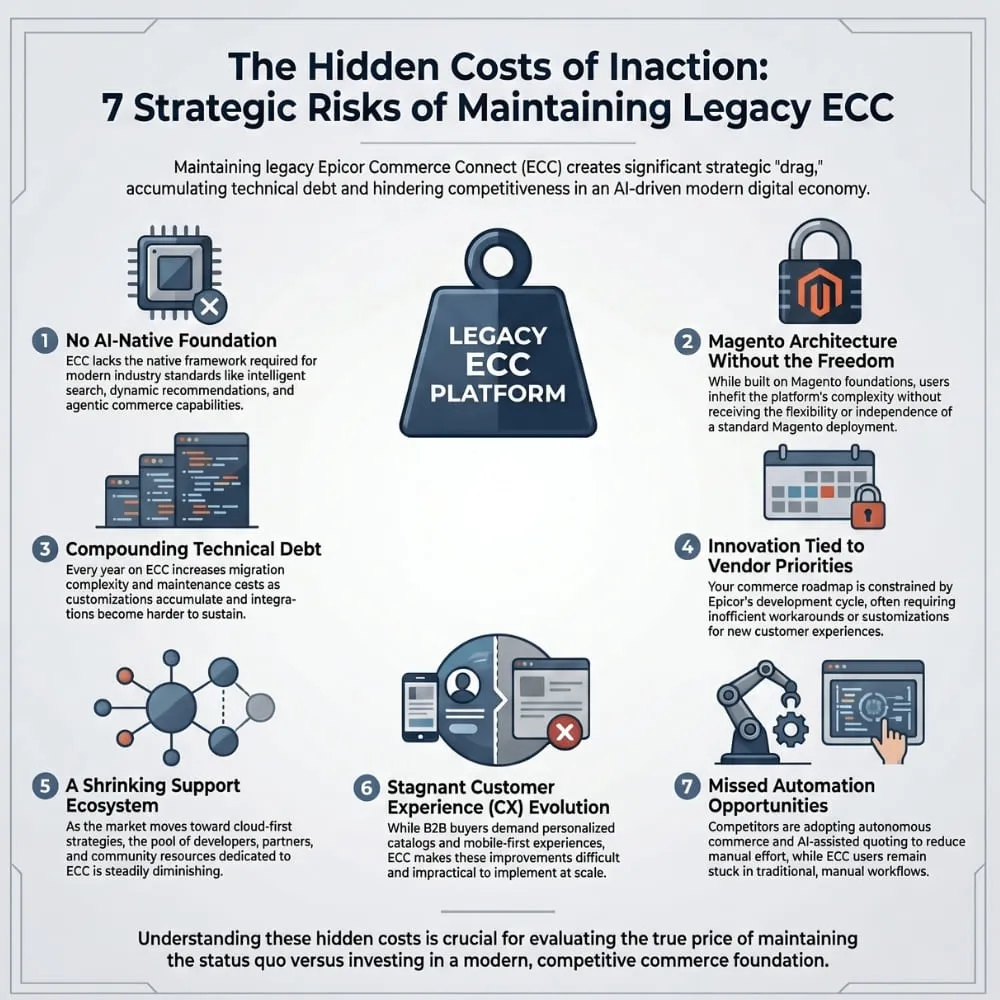
Here’s what staying on ECC is actually costing you today:
- No AI-Native Foundation
Modern commerce platforms are embedding AI across search, merchandising, pricing, customer service, and purchasing workflows. ECC lacks a native framework for intelligent search, dynamic recommendations, predictive ordering, and agentic commerce capabilities that are becoming standard across the industry. - Innovation Constrained by Epicor’s Priorities
Your commerce roadmap is tied to Epicor’s development priorities. New customer experiences, frontend enhancements, and emerging commerce capabilities often require workarounds, customizations, or waiting for platform updates outside your control. - Magento Architecture Without Magento Freedom
ECC is built on Magento foundations, but businesses don’t receive the full flexibility of an independent Magento deployment. You inherit platform complexity while remaining constrained by Epicor’s ecosystem and release cycles. - Growing Technical Debt
Every year spent on ECC increases migration complexity. Customizations accumulate, integrations become harder to maintain, and the eventual cost of modernization rises. Delaying a migration rarely makes it easier—it typically makes it more expensive. - A Shrinking Ecosystem
As Epicor customers evaluate cloud-first commerce strategies, the pool of developers, implementation partners, extensions, and community resources dedicated to ECC continues to shrink. Finding expertise becomes more difficult and more costly over time. - Limited Customer Experience Evolution
B2B buyers increasingly expect the same convenience they experience in consumer ecommerce—personalized catalogs, fast search, seamless reordering, and mobile-first purchasing experiences. ECC makes these improvements possible, but often not practical at scale. - Missed Automation Opportunities
Modern platforms are moving beyond ecommerce into autonomous commerce. From AI-assisted quoting and customer service to automated replenishment and purchasing agents, competitors are reducing manual effort across the buying journey while ECC users continue relying on traditional workflows.
The core issue isn’t that ECC is failing. It’s that the gap between what ECC was designed to do and what modern commerce platforms can do is widening every year. The longer that gap exists, the harder it becomes to compete on customer experience, operational efficiency, and digital growth.
Choosing the Right eCommerce Platform for Your Post-ECC Future
Moving off ECC isn’t simply a migration project—it’s an opportunity to rethink the role commerce plays in your business. The platform you choose today will determine how quickly you can adapt to new customer expectations, integrate emerging AI capabilities, and support future growth without another major replatforming effort a few years down the road.
While all four platforms can connect to Epicor ERP, they take fundamentally different approaches to customization, B2B functionality, AI enablement, ongoing maintenance, and total cost of ownership. Some prioritize flexibility and deep customization. Others focus on speed, simplicity, and lower operational overhead. The right choice depends on your business model, technical resources, catalog complexity, and long-term digital commerce strategy.
Here’s how the leading ECC migration platforms compare.
Adobe Commerce
Adobe Commerce is the enterprise version of Magento, designed for organizations with complex B2B operations, sophisticated customer experiences, and long-term scalability requirements. As part of the Adobe Experience Cloud ecosystem, it combines Magento’s flexibility with enterprise-grade support, security, and AI-powered capabilities through Adobe Sensei.
For ECC users managing large catalogs, customer-specific pricing, multi-site operations, and advanced quoting workflows, Adobe Commerce offers one of the most powerful foundations available. Its open architecture enables deep Epicor ERP integrations while supporting advanced personalization, intelligent merchandising, and AI-driven customer experiences.
The tradeoff is investment. Adobe Commerce requires licensing, implementation, and ongoing development resources, making it best suited for businesses that can fully leverage its enterprise capabilities.
BigCommerce
BigCommerce occupies the middle ground between enterprise flexibility and SaaS simplicity. It delivers a strong native B2B feature set—including customer groups, price lists, purchase orders, and net payment terms—without requiring extensive custom development.
For ECC users seeking modern commerce capabilities without the operational complexity of managing a Magento-based platform, BigCommerce offers a compelling balance of functionality, speed, and predictable costs. Its API-first architecture also supports Epicor integrations while maintaining a lower maintenance burden than self-hosted solutions.
AI capabilities continue to expand through BigCommerce’s partner ecosystem, making it an attractive option for organizations seeking innovation without extensive technical overhead.
Shopify Plus
Shopify Plus is designed for businesses that prioritize speed, simplicity, and operational efficiency. It provides the fastest path to a modern commerce experience while minimizing infrastructure and maintenance responsibilities.
Recent investments in Shopify Magic, Sidekick, and AI-assisted merchandising tools have positioned Shopify as one of the most accessible AI-enabled commerce platforms for lean teams. Businesses can launch quickly, manage operations easily, and benefit from continuous platform innovation without significant technical resources.
Magento Open Source
Magento Open Source provides the same core commerce architecture without Adobe’s licensing costs. For many ECC users, it represents the most familiar migration path because ECC itself was built on Magento technology.
The platform gives businesses complete ownership of their commerce stack, allowing unlimited customization and control over both storefront functionality and ERP integrations. It is also one of the strongest foundations for AI-native commerce initiatives, enabling organizations to build custom search experiences, agentic purchasing workflows, and LLM-powered applications without platform restrictions.
The advantage is flexibility. The responsibility is ownership. Businesses must manage hosting, security, maintenance, and platform upgrades themselves or through an experienced Magento partner.
For ECC users with straightforward catalogs, standardized B2B requirements, or blended B2B and D2C operations, Shopify Plus can significantly accelerate modernization efforts. Organizations with highly customized workflows or complex ERP-dependent business processes should carefully evaluate platform limitations before committing.
The ECC Migration Matrix
Every ECC business has different priorities. This matrix evaluates all four platforms across the factors that matter most for ECC users — with AI and agentic commerce readiness scored as a first-class criterion, not an afterthought.
| Adobe Commerce | Magento Open Source | BigCommerce | Shopify Plus | |
|---|---|---|---|---|
| Epicor ERP Integration | Enterprise connectors + custom middleware. Full data mapping for Kinetic, P21, Eclipse. | You own the integration layer entirely. Most flexible of all four — custom-built to spec. | Third-party connectors. Solid for standard B2B flows; less flexible for complex mapping. | Growing connector ecosystem. Best fit for simpler ERP setups and standard order sync. |
| AI & Agentic Commerce | Adobe Sensei AI built in. Extensible for agentic quoting, LLM-driven workflows via enterprise APIs. | Maximum freedom — build and own any AI agent, LLM integration, or agentic workflow from scratch. | Growing AI app ecosystem. Agentic capabilities via platform partners; less native depth. | Shopify Magic + Sidekick. Best out-of-the-box AI for non-technical teams. Less extensible for deep builds. |
| B2B Feature Depth | Full enterprise B2B: tiered pricing, custom catalogs, quote workflows, multi-site. Highly extensible. | Same Magento B2B architecture as Adobe Commerce. Fully customizable; requires dev to configure. | Strongest out-of-the-box SaaS B2B: price lists, customer groups, POs, net terms — no heavy dev. | Mature Shopify B2B with blended D2C. Lighter than Magento options for complex distributor logic. |
| Customization Flexibility | Near-unlimited via extensions and custom dev. Enterprise governance on Magento core. | Near-unlimited. Open source, full codebase access, no licensing constraints. | Mid-range. Strong apps and themes; platform boundaries limit low-level customization. | High via apps and Liquid. Core platform is closed — you work within Shopify's constraints. |
| Total Cost of Ownership | Higher licensing + dev + hosting. Adobe licensing is a significant line item. | Lowest licensing (open source). Investment goes to dev, hosting, and agency. | Predictable SaaS pricing. App costs accumulate. No hosting overhead. | Predictable SaaS. Transaction fees and app stack grow. Lowest entry cost. |
| Time to Go Live | 4–9+ months for complex builds. A substantial implementation project. | 3–8 months. Complexity is in custom dev and ERP integration, not licensing. | 2–5 months. Native B2B tools reduce build time vs. Magento-based options. | 1–3 months. Best option when speed to market is the top priority. |
| Ongoing Maintenance | High — active agency or dev team required for patches, updates, and feature work. | High — you own infrastructure, security, and updates. Maximum control, maximum responsibility. | Low — SaaS handles infrastructure and security. Team manages store config and apps. | Lowest — fully managed SaaS. Minimal technical overhead by design. |
| Best Fit | Enterprise with complex operations, Adobe stack, dedicated technical resources. | Mid-market to enterprise wanting Magento power without Adobe licensing. | SMB to mid-market. Strong B2B needs, lean IT team, predictable budget. | SMB to mid-market. Simpler ERP setup, fast launch priority, blended B2B + D2C. |
Which Platform Fits Your Business?
Choose Adobe Commerce if…
- You need enterprise Magento with full vendor support, SLAs, and security coverage
- You’re already in the Adobe Experience Cloud ecosystem
- Your Epicor ERP integration requires deep custom data mapping a SaaS connector can’t handle — with enterprise support behind it
- Your budget supports Adobe licensing plus an experienced implementation partner
Choose BigCommerce if…
- You need strong out-of-the-box B2B without committing to a full custom development project
- Predictable SaaS costs and lower maintenance overhead are priorities
- Your ECC setup was moderately complex but not deeply customized
- Faster time to go live than a Magento-based build matters to your business timeline
Choose Shopify Plus if…
- Your ECC setup was relatively standard — clean catalog, manageable B2B logic, straightforward ordering
- Speed of migration and simplicity of ongoing management are your top priorities
- You have a lean IT team and need a platform your business can run without heavy agency dependency
Choose Magento Open Source if…
- You want full Magento power without Adobe’s licensing cost
- Owning your codebase and ERP integration layer — independent of any vendor — is a strategic priority
- You want maximum flexibility to build agentic commerce: custom AI agents, LLM-powered search, autonomous reordering — on your timeline, not a platform’s
- You have a capable Magento agency partner to own the build and ongoing development
Not sure which platform fits? DotcomWeavers can help you choose and migrate with confidence. Get on a discovery call with our Epicor and eCommerce experts.
One Thing Doesn’t Change: Your Epicor ERP
Whichever platform you move to, your Epicor ERP stays in place. What changes is how your commerce platform connects to it — and as Epicor moves to cloud infrastructure, that connection needs to be rebuilt regardless. The question is whether you rebuild it back to ECC or forward to a platform built for where your commerce is going.
- Adobe Commerce: Enterprise connectors plus custom middleware for complex Kinetic, P21, and Eclipse integrations.
- BigCommerce: Third-party ERP connectors. Solid for standard B2B data flows; less flexible for custom ERP logic.
- Shopify Plus: Growing connector ecosystem. Best suited for simpler ERP relationships with standard order and inventory sync.
- Magento Open Source: You own the integration layer entirely. Custom-built to your exact specifications. Familiar Magento architecture from your ECC setup.
The most common migration failure: businesses execute the platform build well, then discover the ERP reconnection was underplanned. Pricing isn’t flowing, inventory sync is broken, orders aren’t reaching the ERP correctly. This is a planning problem — but it’s expensive to fix after go-live.
DotcomWeavers handles both sides of this migration as a single integrated project. The team that builds your storefront is the same team that rebuilds your Epicor connection — no handoffs, no scope gaps.
What the Migration Actually Involves
Four workstreams drive every ECC migration. The complexity of each depends on your platform choice.
- Data migration — products, customers, order history, pricing rules. Standard catalogs move cleanly. Attribute-heavy B2B catalogs with layered contract pricing need careful mapping.
- ERP integration — your Epicor connection needs to be rebuilt for the new platform architecture. Plan this as a primary workstream, not a post-launch task.
- Frontend and UX — your first real opportunity to build a storefront that isn’t constrained by Epicor’s roadmap. AI-powered search, personalization, and agentic features get built in here.
- Business logic — pricing rules, customer tier logic, approval workflows, quote-to-order flows. The more complex your B2B logic, the more this workstream dominates your timeline.
Common mistakes ECC businesses make:
- Choosing a platform based on vendor familiarity rather than fit for their catalog and ERP complexity
- Underestimating data mapping work, especially for B2B pricing and customer account structures
- Treating ERP reconnection as a post-launch task rather than a primary project workstream
Whichever Platform You Choose, DotcomWeavers Can Get You There.
A single-platform agency gives you one answer. That’s how specialization works — and it means their recommendation reflects their capability, not necessarily your fit. DotcomWeavers is certified on all four platforms. Our job is to match your specific situation to the platform that actually fits it, then execute the migration without gaps between the storefront build and the ERP reconnection.
We’ve migrated 20+ Epicor-powered businesses across Eclipse, Prophet 21, Kinetic, and BisTrack. That depth means fewer surprises, faster timelines, and integrations that hold up post-launch.
The Right Migration Isn’t Just About Leaving ECC—It’s About What Comes Next
Epicor’s move to a cloud-first future has made one thing clear: staying on ECC is no longer a long-term commerce strategy. While ECC continues to serve its purpose today, the gap between legacy commerce and modern AI-enabled commerce continues to widen. Intelligent search, personalized buying experiences, autonomous purchasing workflows, and scalable B2B self-service capabilities are quickly becoming competitive necessities rather than differentiators.
The good news is that this migration window creates an opportunity to do more than replace a platform. It gives you the chance to modernize your entire commerce ecosystem. Whether that means the enterprise power of Adobe Commerce, the flexibility of Magento Open Source, the balanced SaaS approach of BigCommerce, or the simplicity and speed of Shopify Plus, the right platform is the one that aligns with your business model, ERP complexity, growth plans, and long-term digital strategy.
What ultimately determines success, however, is not just the platform you choose—it’s how well the migration is planned and executed. Data migration, ERP integration, business logic mapping, and customer experience modernization all need to work together as a single initiative.
Why DotcomWeavers Is the Right Partner for Your ECC Migration
Choosing the right platform is only half the challenge. The real success of an ECC migration depends on how well your commerce platform, ERP, data, customer experience, and future AI strategy come together.
DotcomWeavers brings expertise across all the critical pieces of the migration journey. We’ve successfully delivered 20+ Epicor ERP integration projects spanning Kinetic, Prophet 21, Eclipse, and BisTrack, along with numerous commerce migrations across Adobe Commerce, Magento Open Source, BigCommerce, and Shopify Plus. This gives us a unique advantage: we understand both sides of the equation—the commerce platform and the ERP systems that power your business.
Beyond platform implementation, we’re helping businesses prepare for the next generation of digital commerce. From AI-powered search and merchandising to intelligent quoting, predictive ordering, and emerging agentic commerce workflows, we build solutions that don’t just solve today’s requirements—they create a foundation for what’s next.
Unlike single-platform agencies that recommend the tools they sell, our platform-agnostic approach ensures every recommendation is based on your business goals, catalog complexity, ERP environment, and long-term growth strategy. Whether you need enterprise-grade flexibility, SaaS simplicity, or an AI-ready commerce architecture, we help you choose the platform that fits—not the platform we’re trying to push.
Most importantly, we execute the entire project as one connected initiative. The same team responsible for your storefront, ERP integration, data migration, and AI roadmap works together from strategy through launch, eliminating the handoffs and gaps that often derail complex migrations.