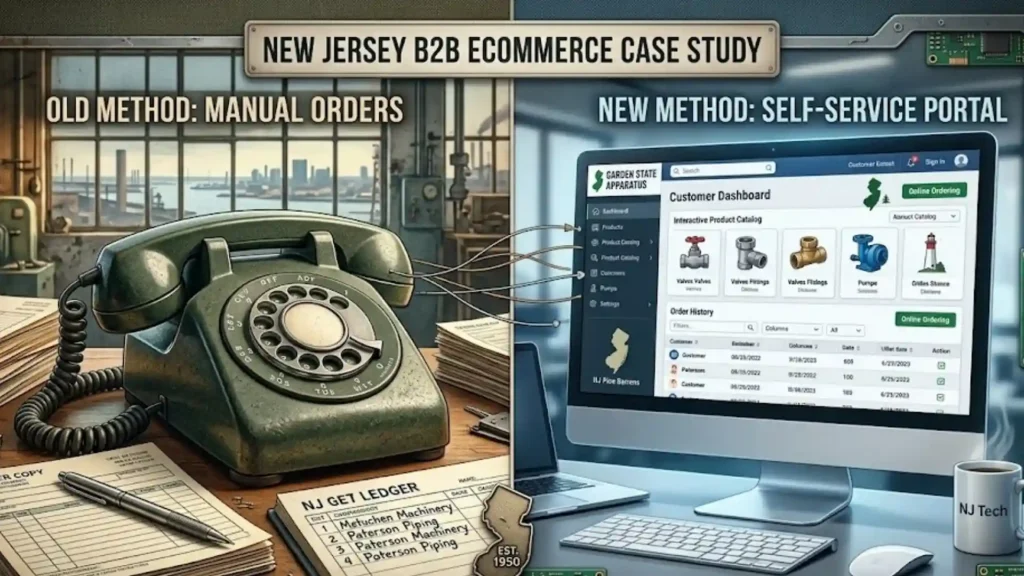
Across New Jersey B2B Ecommerce businesses are facing growing pressure to modernize how they sell online. Legacy sales models built around phone calls, emailed PDFs, and manual order entry may have worked in the past, but today, they create friction, slow down operations, and limit scalability. As product catalogs grow and buyer expectations rise, these disconnected systems become harder to manage and even harder to grow with.
Modern B2B buyers now expect the same efficiency they experience in B2C ecommerce. They want instant access to accurate product information, reliable search results, and tools that help them find the right parts without back-and-forth communication. Most importantly, they want the ability to place orders on their own terms, any time, without waiting for sales teams to intervene.
This case study highlights how a B2B pump products company responded to this shift. By moving from a basic, content-driven WordPress website to a fully functional self-service ecommerce portal, the business redefined how customers interact with its catalog and sales process. The transformation focused on improving usability, strengthening system integration, and enabling buyers to confidently self-serve—while preserving existing internal workflows and operational efficiency.
In this blog, we’ll explore:
- Why the Right Magento Development Partner Matters in New Jersey
- What This Means for New Jersey B2B Ecommerce Businesses
- Why DotcomWeavers for Magento Development in New Jersey
- Ready to Build a Scalable B2B Ecommerce Experience?
Why the Right Magento Development Partner Matters in New Jersey
As B2B companies across New Jersey move toward self-service ecommerce, the technology stack alone is not enough. Success depends heavily on choosing a Magento development company that understands the complexity of B2B buying, system integrations, and industry-specific workflows.
Magento Open Source is a powerful platform, but unlocking its full potential requires deep expertise in custom development, ERP integration, search optimization, and conversion-focused UX. For New Jersey-based manufacturers and distributors, this often means working with a partner that can bridge strategy, technology, and execution without disrupting day-to-day operations.
DotcomWeavers is a New Jersey–based Magento development company with extensive experience building B2B ecommerce solutions for complex product catalogs and operational environments. As a Gold Adobe Partner, DotcomWeavers specializes in creating scalable Magento solutions that go beyond storefront design, focusing on system connectivity, buyer enablement, and measurable business outcomes.
This case study reflects that approach in action, showcasing how a carefully planned Magento implementation can replace manual, phone-driven sales processes with a streamlined self-service portal, while maintaining alignment with existing business workflows.
The Business Context
Pump Products operates in a highly specialized B2B environment where accuracy is critical. Customers are not browsing casually; they are searching for specific parts, verifying compatibility, and placing orders that directly impact equipment performance and operations. In this kind of buying journey, even small gaps in product information or navigation can lead to delays, incorrect orders, or abandoned purchases.
At the time, the company’s website was built on WordPress and functioned primarily as an informational presence. While it offered basic visibility into the brand and its offerings, it was not designed to support transactional B2B commerce. The platform lacked the structure, flexibility, and tools needed to handle complex product relationships and buyer expectations.
As a result, customers often depended on phone calls and manual assistance to identify the right parts, confirm details, and complete orders. This not only slowed down the buying process but also placed a heavy burden on internal teams, who had to bridge the gap between customer inquiries and backend systems manually.
Over time, this disconnect created friction on both sides—buyers struggled to self-serve, and internal teams spent valuable time managing routine requests instead of focusing on higher-value sales and support activities.
Key Challenges
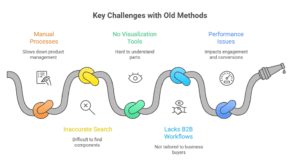
Before the ecommerce transformation, Pump Products faced a combination of operational and user experience challenges that limited growth and efficiency:
- Customers had limited ability to independently search for and identify the correct products, especially when dealing with complex parts.
- Product and catalog management relied heavily on manual processes due to the absence of ERP connectivity.
- Search functionality lacked accuracy, making it difficult for users to find relevant components quickly.
- There were no interactive tools to help customers visualize machines and understand how individual parts fit together.
- The platform lacked structured B2B workflows tailored to business buyers and real-world purchasing processes.
- Performance and navigation issues negatively impacted engagement, contributing to higher bounce rates and lower conversions.
Collectively, these challenges slowed down the buying journey, reduced confidence in self-service purchasing, and limited the site’s ability to convert high-intent traffic into completed orders.
The Strategic Approach
The objective was not simply to launch an ecommerce website, but to build a self-service B2B portal capable of supporting real purchasing behavior in a complex product environment.
The strategy focused on three core pillars:
- Platform scalability to support a growing catalog and evolving business needs
- System integration to eliminate manual processes and improve data accuracy
- Conversion-focused user experience to reduce friction and guide buyers through confident purchasing decisions
Every decision was aligned with creating a more efficient, accurate, and buyer-friendly ecommerce experience, without disrupting existing operational workflows.
Solution Overview
To address the identified challenges, a series of targeted solutions was implemented:
Migration to Magento Open Source
The website was migrated from WordPress to Magento Open Source to enable advanced ecommerce capabilities, support complex product catalogs, and accommodate B2B-specific workflows. This shift provided a flexible and scalable foundation while allowing for deep customization aligned with business requirements.
Custom ERP Integration
A custom ERP integration was developed to streamline product and catalog management. By synchronizing data between systems, this integration reduced manual effort, improved data accuracy, and enabled more efficient internal operations.
AI-Based Search for Better Discoverability
Search functionality was enhanced using AI-based search capabilities to improve accuracy and relevance. Users could locate products more efficiently, even within a large and complex catalog, significantly improving product discoverability and reducing time spent searching.
Enhanced Parts Finder
A robust parts finder was implemented to help customers quickly identify compatible components. By guiding users to the correct selections, this feature played a key role in increasing both conversion rates and average order value.
Interactive Machine Diagrams
Interactive machine diagrams were developed to visually represent equipment and associated parts. These diagrams allowed users to explore machines in detail and add parts directly to their cart, reducing errors and simplifying the purchasing process.
Custom B2B Features and Sales Workflows
Custom B2B functionality was built to support business buyers, including tailored sales workflows that reflected real-world B2B transaction processes. This helped bridge the gap between traditional sales models and modern self-service ecommerce.
Conversion-Driven UI/UX Design
The user interface and overall experience were redesigned with conversion as a priority. Improved navigation, clearer product pathways, and performance optimizations reduced friction throughout the buyer journey and encouraged completion of purchases.
Multichannel Integration
Multichannel integration ensured consistency across systems and touchpoints, enabling smoother operations and a more connected commerce ecosystem.
Performance Gains
The impact of the implemented solutions translated into clear, measurable improvements across both user experience and business performance.
Enhanced site speed and improved navigation increased overall user engagement, making it easier for buyers to move through the catalog and complete purchases. Search accuracy improved significantly, enabling faster and more reliable product discovery—especially critical for complex parts and components.
Conversion-focused UX tools, including interactive machine diagrams and guided buying features, helped reduce friction throughout the purchasing journey. The introduction of a robust parts finder not only simplified product selection but also encouraged higher-value orders. On the operational side, custom workflows improved product catalog management, enabling greater efficiency and scalability.
Measurable Business Impact
- 30% increase in conversions, driven by improved usability and buyer enablement
- 20% reduction in bounce rate, reflecting faster load times and clearer navigation
- 20% increase in average order value (AOV), supported by a guided parts-finding experience
These performance gains highlight how aligning platform capabilities, system integration, and user experience can directly influence engagement, efficiency, and revenue growth in a B2B ecommerce environment.
What This Means for New Jersey B2B Ecommerce Businesses
This case study reflects a broader shift in how B2B buyers across New Jersey want to engage with digital commerce. Buyers no longer see ecommerce as a secondary channel—they expect it to work as a primary, reliable way to research products, validate compatibility, and place orders with confidence.
Self-service ecommerce does not replace sales teams. Instead, it removes friction from routine, repetitive transactions and enables customers to move faster. When buyers can independently find accurate information and complete orders, sales teams gain more time to focus on complex deals, relationship building, and strategic growth.
For B2B companies struggling with challenges such as:
- Poor search accuracy makes product discovery difficult
- Outdated or manual data management processes
- Slow site performance that increases bounce rates
- Limited engagement tools for both B2B and B2C buyers
- Complex navigation structures that discourage self-service
This case study demonstrates that these issues are not isolated problems—they are interconnected. Addressing them requires a modern ecommerce platform supported by thoughtful system integrations and a user experience designed around real buying behavior.
When implemented correctly, ecommerce becomes an operational advantage rather than a bottleneck.
From Phone Orders to Scalable B2B Commerce
The Pump Products transformation shows that moving from phone-based ordering to a self-service B2B portal is not simply a technology upgrade; it is a strategic shift in how a business operates and grows.
By migrating from WordPress to Magento Open Source, integrating ERP systems, and prioritizing buyer-focused features such as advanced search, parts finders, and interactive machine diagrams, the business created a scalable ecommerce foundation. The result was improved efficiency, better data accuracy, and measurable gains in conversions, engagement, and order value, all without disrupting existing internal workflows.
For New Jersey-based B2B manufacturers and distributors, this approach provides a practical blueprint for modernizing ecommerce while maintaining operational control.
Why DotcomWeavers for Magento Development in New Jersey
This case study also highlights the importance of choosing the right Magento development partner. Magento Open Source offers powerful capabilities, but real results depend on how those capabilities are implemented and aligned with business processes.
DotcomWeavers is a New Jersey–based Magento development company with deep experience delivering B2B ecommerce solutions for complex product environments. As a Gold Adobe Partner, DotcomWeavers focuses on more than just storefront development, bringing together platform strategy, ERP integration, conversion-driven UX, and long-term scalability.
The Pump Products case study reflects DotcomWeavers’ approach: solving real operational challenges, enabling buyer self-service, and delivering measurable business outcomes through carefully executed Magento implementations.
For B2B companies in New Jersey looking to move beyond phone orders and manual processes, this case study demonstrates what’s possible when ecommerce strategy, technology, and execution come together under the right Magento development partner.
Ready to Build a Scalable B2B Ecommerce Experience?
If your B2B business is still relying on phone orders, manual processes, or an ecommerce platform that can’t support complex buying journeys, it may be time to rethink your approach.
DotcomWeavers helps New Jersey–based manufacturers and distributors design, build, and optimize Magento Open Source solutions that support self-service buying, system integration, and measurable growth. From ERP integration and advanced search to conversion-driven UX, our team focuses on solving real operational challenges, not just launching websites.
Talk to our Magento experts to see how a tailored B2B ecommerce strategy can improve efficiency, accuracy, and conversions, without disrupting your existing workflows.