Let’s dive deeper into every aspect to give you a complete picture.
The Cost of Poor Lead Qualification in B2B
For B2B companies, especially those in eCommerce, conversion success isn’t about driving traffic—it’s about qualifying the right traffic. Yet, sales and marketing teams often find themselves chasing unqualified leads, leading to bloated pipelines, missed opportunities, and wasted budgets.
Traditional lead scoring is slow, manual, and often subjective. It relies heavily on human assumptions rather than data-driven insights, which in turn leads to poor prioritization, delayed follow-ups, and longer sales cycles.
Enter predictive lead scoring software powered by AI—a game-changer that uses real-time data and machine learning to rank leads based on actual buying intent. This blog will explore how predictive scoring can streamline your sales process, boost conversions, and help B2B companies like yours grow more efficiently.
What is Predictive Lead Scoring?
Predictive lead scoring is the use of artificial intelligence and machine learning to automatically evaluate and rank leads based on how likely they are to convert into paying customers.
Unlike traditional models, which rely on rule-based scoring (e.g., +10 points for downloading a whitepaper), predictive models analyze massive datasets and patterns that humans might miss. These models are constantly learning and adjusting, resulting in more accurate scores and better prioritization.
In simple terms, predictive scoring = smarter prioritization + faster conversions.
Traditional vs. Predictive Lead Scoring
| Feature | Traditional Lead Scoring | Predictive Lead Scoring |
|---|---|---|
| Method | Manual point-based system | Machine learning & AI algorithms |
| Data Sources | Limited (form fills, clicks) | Broad (behavioral, firmographic, intent, CRM, 3rd-party) |
| Scalability | Difficult to manage at scale | Easily handles thousands of leads |
| Accuracy | Based on assumptions | Based on real-time data patterns |
| Bias | Subjective, inconsistent | Objective and dynamic |
How AI-Based Lead Scoring Works
AI models use machine learning to analyze historical data—closed-won and closed-lost opportunities—and determine patterns that separate good leads from bad ones. The model then applies this pattern recognition to score new leads in real time.
Steps in the process:
- Data Ingestion: AI pulls from CRM, email tools, web analytics, and external intent platforms.
- Model Training: Machine learning trains on past conversions to recognize successful behaviors.
- Lead Scoring: Each new lead is assigned a score from 0 to 100 based on likelihood to convert.
- Continuous Learning: As more deals close, the model improves itself.
AI doesn’t just evaluate what a lead has done—it predicts what they’re likely to do next.
Why Predictive Lead Scoring is a Game-Changer for B2B eCommerce
B2B eCommerce isn’t just a transactional environment—it’s complex, high-value, and often relationship-driven. That’s why predictive lead scoring is especially powerful for:
- Segmenting complex catalogs: Not all visitors are looking for the same thing—AI identifies purchase intent faster.
- Shortening sales cycles: Reps focus on high-scoring leads who are ready to buy.
- Improving support: Operations teams can tailor onboarding or upselling based on scoring.
- Scaling efficiently: AI handles thousands of leads simultaneously, removing bottlenecks.
Data Inputs that Fuel Predictive Models
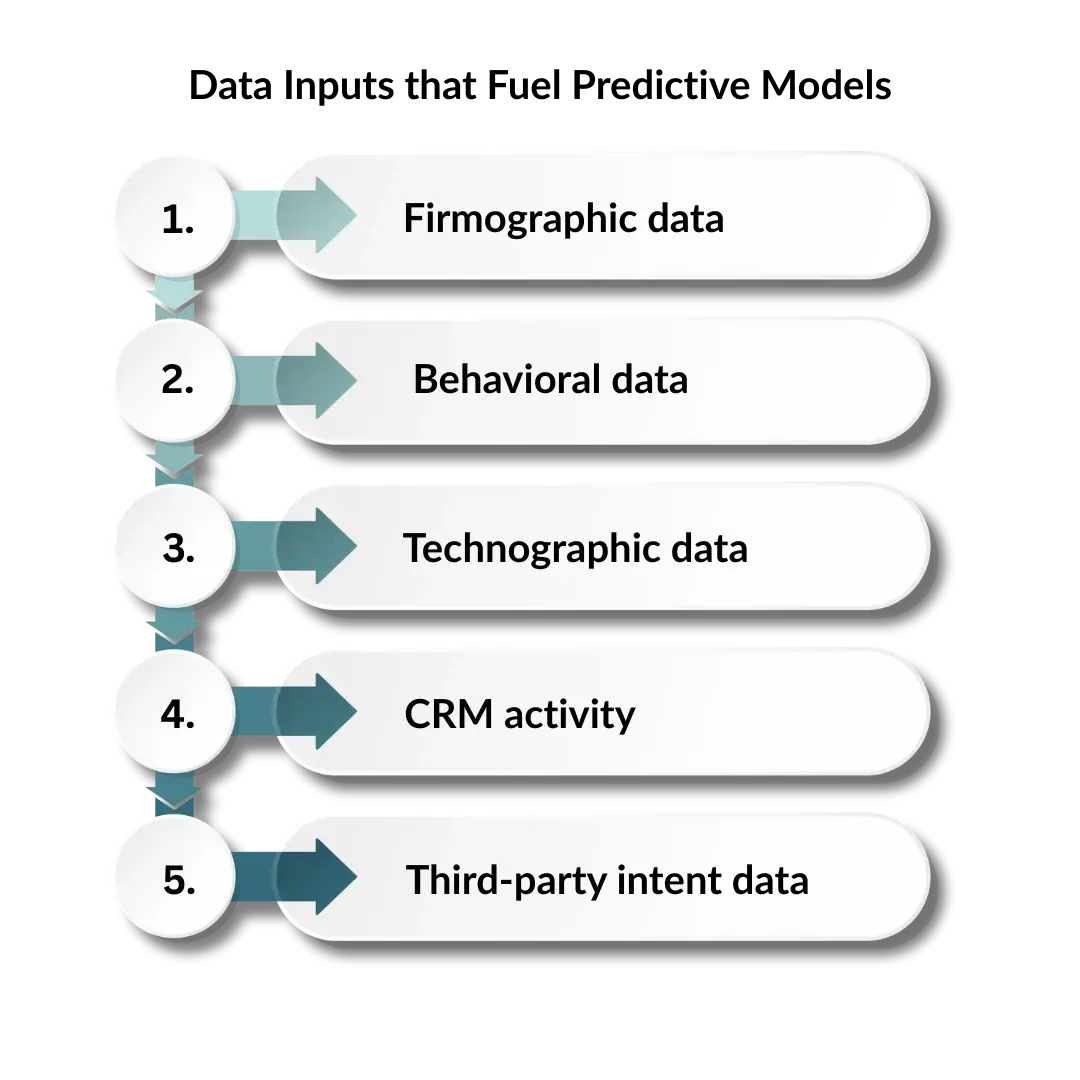
The accuracy of any AI scoring model depends on the quality and variety of data fed into it. Key sources include:
- Firmographic data: Company size, revenue, industry, location
- Behavioral data: Pages viewed, time on site, downloads, email opens
- Technographic data: Tech stack, integrations, platform usage
- CRM activity: Sales touchpoints, meeting notes, deal stage
- Third-party intent data: From tools like Bombora, ZoomInfo, or G2
With this multi-layered data, AI models can detect real purchase signals rather than relying on superficial engagement.
Key Metrics Improved by Predictive Lead Scoring
| Metric | Impact |
|---|---|
| Lead-to-Opportunity Conversion | Higher accuracy in lead targeting improves conversion rates |
| Sales Cycle Length | Shortened by prioritizing hot leads |
| Sales Productivity | More time spent selling, less time qualifying |
| Customer Acquisition Cost (CAC) | Lower CAC due to smarter resource allocation |
| Close Rate | Better follow-ups = higher win rates |
Integration with CRMs, CDPs, and Marketing Automation Tools
A predictive lead scoring system isn’t a standalone product—it’s a crucial cog in your marketing and sales stack. That’s why integration matters.
Common platforms integrated:
- CRM: Salesforce, HubSpot, Zoho
- CDP: Segment, BlueConic
- MAP: Marketo, Pardot, ActiveCampaign
- BI tools: Power BI, Tableau
At DotcomWeavers, we help clients design a unified data architecture so that your AI scoring system works in real-time across all touchpoints.
Building a Scoring Model: Strategy, Setup, and Maintenance
Define “conversion”
What constitutes a qualified lead? It differs for every business.
Collect and clean historical data
The model needs a clean dataset to identify patterns.
Choose a Model Approach
Logistic regression, decision trees, and neural networks each have their uses.
Train and validate
Test the model with recent leads and refine as needed.
Roll out with sales alignment
Ensure SDRs and AEs understand how scores are assigned and how to act on them.
Personalizing Follow-Ups with AI Scoring Insights
Lead scores don’t just say who to follow up with—they inform how to follow up.
- High scorers → Direct outreach with demo invite
- Medium scorers → Nurture with targeted emails
- Low scorers → Recycle or remarket later
AI helps create lead-stage-specific content, ensuring every interaction feels tailored—even if it’s automated.
Improving Sales-Marketing Alignment Through Shared Insights
One of the biggest challenges in B2B is the disconnect between marketing and sales.
AI scoring provides a shared language and data-driven framework to align both teams:
- Marketing focuses on delivering high-quality leads, not just MQL volume
- Sales gains confidence in lead quality and prioritization
- Both teams can measure attribution and optimize the funnel together
This alignment boosts not only conversion rates but also internal collaboration.
Challenges to Avoid in Predictive Lead Scoring Implementation
Even powerful tools can underdeliver if implemented poorly. Watch out for:
- Bad data hygiene: Garbage in, garbage out.
- Over-reliance on the model: AI supports decisions—it doesn’t replace strategy.
- Poor user adoption: If sales don’t use the scores, you’ve lost the value.
- Static models: Failing to retrain models makes them obsolete.
At DotcomWeavers, we ensure predictive scoring is rolled out with clean data, human oversight, and performance feedback loops.
Why DotcomWeavers for Predictive Lead Scoring and AI Automation
DotcomWeavers combines deep technical knowledge with marketing strategy to deliver custom AI transformation solutions for B2B.
We help clients:
- Set up predictive lead scoring models using custom or third-party tools
- Integrate scores across CRMs, ERPs, MAPs, and CDPs
- Improve conversion optimization through AI insights
- Build real-time dashboards for sales and marketing teams
- Enable full-funnel visibility and campaign optimization
Our Marketing Automation Services and AI-powered demand generation strategies are designed specifically for long-cycle B2B sales environments.
If you’re looking to buy a B2B lead qualification platform or implement a custom AI scoring engine, we’re here to help you make it successful.
Future of Predictive Scoring: From Leads to Lifecycle Intelligence
The next evolution of AI lead scoring isn’t just about lead qualification—it’s about managing the entire customer lifecycle.
Imagine scoring:
- Churn risk for existing accounts
- Upsell likelihood within product lines
- Referral or advocacy potential
By applying predictive analytics to the full journey, businesses can build long-term growth strategies that are insight-driven and scalable.
Predictive lead scoring offers B2B companies the opportunity to eliminate inefficiency, improve targeting, and accelerate sales—all with the power of AI.
Instead of relying on static scoring models or gut feelings, teams can make confident, data-backed decisions about who to pursue and how to engage.
Whether you’re trying to increase close rates, shorten cycles, or get more ROI from marketing, predictive scoring is no longer a luxury—it’s a necessity.
About the Author: Amit Bhaiya

Receive a Personalized Consultation for Your eCommerce Requirements!
Receive a Personalized Consultation for Your eCommerce Requirements!