
For over a decade, Magento has been the go‑to platform for brands that need flexibility, deep customization, and enterprise‑grade control. But as we step into 2026, the conversation has shifted.
Merchants aren’t asking “What can we customize?” anymore.
They’re asking:
- Why does every update feel risky?
- Why does performance depend so heavily on infrastructure management?
- Why does scaling globally still require so much development effort?
This is where Magento to BigCommerce migration has become a serious, board‑level discussion, not a trend, not a downgrade, and definitely not a shortcut.
BigCommerce has matured into a platform that balances speed, scalability, security, and cost efficiency, without forcing merchants into constant backend firefighting. For many mid‑market and enterprise brands, moving from Magento to BigCommerce is no longer about what they lose, but what they finally stop paying for.
This guide is built to help decision‑makers understand:
- Moving from Magento to BigCommerce makes sense
- The real cost implications (beyond licensing)
- SEO, data, and B2B migration considerations
- Performance and operational differences
- And importantly, when you should NOT migrate
Balanced, practical, and experience‑driven—because Google rewards credibility, and so do smart merchants.
Magento vs BigCommerce in 2026: A Platform Reality Check
Before diving into migration mechanics, it’s important to understand how Magento and BigCommerce fundamentally differ today—not just in features, but in how they are built, operated, and scaled. In 2026, platform decisions are no longer driven by what’s possible. They’re driven by what’s sustainable.
Core Platform Philosophy
At their core, Magento and BigCommerce follow very different architectural and operational philosophies.
Magento is a powerful, self-managed ecosystem designed for maximum backend control.
- Highly customizable across catalog, pricing, checkout, and workflows
- Developer-centric by nature, with most enhancements requiring custom development
- Infrastructure-dependent, with performance and stability tied closely to hosting quality and optimization efforts
Magento is ideal for organizations that want granular control and have the internal resources—or agency support—to manage ongoing complexity.
BigCommerce, by contrast, is a platform-managed SaaS solution built to remove operational burden from merchants.
- Infrastructure, security, performance, and scalability are handled at the platform level
- API-first and headless-ready, enabling frontend flexibility without backend overhead
- Lower dependency on continuous development for core commerce functionality
Instead of managing the platform itself, BigCommerce allows teams to focus on merchandising, customer experience, and growth initiatives.
In 2026, this philosophical difference matters more than feature parity—because most businesses don’t struggle due to missing features. They struggle due to operational friction, rising costs, and limited agility.
Operational Comparison Snapshot (2026 View)
| Area | Magento | BigCommerce |
|---|---|---|
| Hosting | Self-managed infrastructure with ongoing monitoring and scaling responsibility. | Platform-managed infrastructure with built-in scalability. |
| Upgrades | Manual upgrades, patching, and compatibility testing. | Continuous platform updates without merchant-led upgrade cycles. |
| Dev Dependency | Most enhancements require development effort. | Core features are available with less custom build effort. |
| Go-Live Speed | Longer setup and launch timelines. | Faster setup and launch. |
| Operations | Ongoing performance, security, and maintenance effort. | Lower operational involvement post-launch. |
| Scalability | Scales with planning and infrastructure tuning. | Scales automatically with demand. |
| B2B Readiness | Strong B2B support, often customization-heavy. | Native B2B capabilities with configurable workflows. |
| Integrations | Deep customization, tightly coupled builds. | API-first, headless-friendly architecture. |
| Cost Profile | Higher long-term effort and maintenance costs. | More predictable ongoing costs. |
| Best Fit | Businesses needing maximum platform control. | Businesses prioritizing speed and efficiency. |
What This Comparison Really Tells Us
Magento offers control—but that control comes with responsibility for infrastructure, performance tuning, security patching, and upgrade stability.
BigCommerce shifts much of that responsibility to the platform itself, reducing risk, operational overhead, and long-term cost volatility.
That’s why Magento vs BigCommerce in 2026 is no longer a debate about which platform has more features. It’s a decision about operational efficiency, scalability without friction, and how much technical weight your business wants to carry as it grows.
Why Brands Are Moving from Magento to BigCommerce
The decision to move from Magento to BigCommerce rarely stems from a single issue. Instead, it emerges after recurring friction points that impact costs, performance, and growth potential. Leading brands increasingly recognize that a SaaS-first approach offers more predictable, scalable, and efficient eCommerce operations. Here’s why:
Magento to BigCommerce Migration Cost: What You Actually Pay For
Cost is one of the top concerns merchants research before moving from Magento to BigCommerce—and it’s understandable. Magento to BigCommerce migration services involve more than just platform fees; it’s about total cost of ownership, resource allocation, and long-term scalability. Understanding where your money goes is crucial for making an informed decision.
Magento Cost Breakdown (2026 Reality)
Magento’s flexibility and self-hosted architecture come at a price. Beyond the licensing fees for Adobe Commerce, merchants face several ongoing costs:
- License fees – Adobe Commerce’s subscription cost can be high, especially for enterprise-level plans.
- Cloud hosting & scaling – Running Magento on robust infrastructure requires either dedicated servers or cloud solutions with monitoring, load balancing, and scaling capabilities. These costs fluctuate with traffic and business growth.
- Development retainers – Most Magento stores rely on developers for ongoing maintenance, new features, and troubleshooting. Monthly retainer fees or project-based work can add thousands to operational budgets.
- Upgrade projects – Every major Magento release requires a structured upgrade process, testing extensions, and validating customizations to ensure nothing breaks. This often requires dedicated time and additional costs.
- Performance optimization – Slow-loading pages, large catalogs, and traffic spikes necessitate caching, CDNs, and performance tuning—often managed by specialists.
- Security & compliance – Ensuring PCI compliance, applying patches, and proactively managing security vulnerabilities is an ongoing investment.
In short, Magento’s TCO can escalate quickly with store complexity, high traffic, or frequent updates.
BigCommerce Cost Breakdown
- Platform subscription – One predictable monthly or annual fee covers hosting, security, and platform updates.
- Optional enterprise plan – For larger brands, BigCommerce offers additional capabilities like advanced APIs, dedicated support, and B2B-specific features without the overhead of self-hosted architecture.
- Reduced development overhead – Core features, native integrations, and app ecosystem reduce the need for custom development and maintenance.
- Minimal infrastructure spend – Merchants no longer need to manage servers, scaling, or performance monitoring. BigCommerce automatically handles peak loads and infrastructure maintenance.
The Real Difference: Predictability
The biggest advantage of BigCommerce isn’t just cost reduction, it’s financial predictability. CFOs and CTOs increasingly value stable, forecastable costs over raw savings because:
- Budget planning becomes simpler with fewer surprises from infrastructure spikes or emergency fixes.
- Teams can allocate resources toward growth initiatives rather than routine maintenance.
- Scaling internationally or adding new storefronts doesn’t multiply costs unexpectedly.
For many brands, this predictability outweighs even the initial savings, making BigCommerce a strategic choice rather than just a cost-cutting measure.
SEO Considerations for Magento to BigCommerce Migration
SEO is often the highest-stakes aspect of any migration. For many brands, organic search traffic represents a large portion of revenue. A poorly planned migration can erase years of SEO equity, while a carefully executed strategy can actually improve rankings and visibility.
Key SEO Risks During Migration
Migrating from Magento to BigCommerce introduces several SEO pitfalls:
- URL structure changes – Magento’s URL patterns often differ from BigCommerce’s default structure. Changing URLs without proper handling can lead to 404 errors and lost link equity.
- Metadata loss – Page titles, meta descriptions, and H1s may not automatically migrate, potentially reducing relevance and click-through rates.
- Improper redirects – Failing to implement precise 301 redirects from old URLs to new ones can cause severe ranking drops.
- Duplicate content – Inconsistent canonical tags or duplicate product pages can confuse search engines, harming rankings.
- Crawl errors – Broken internal links, misconfigured robots.txt, or missing sitemaps can prevent search engines from indexing the site properly.
SEO-Safe Migration Best Practices
A migration that protects and enhances SEO requires strategic planning and careful execution:
- One-to-one URL mapping – Map every Magento URL to a corresponding BigCommerce URL to preserve link equity.
- 301 redirects at scale – Implement redirects for all changed or deprecated URLs, ensuring smooth traffic transfer.
- Metadata preservation – Maintain page titles, meta descriptions, H1s, and alt text for all pages.
- Canonical alignment – Correctly configure canonical tags to prevent duplicate content issues.
- XML sitemap restructuring – Update the sitemap to reflect new URLs, enabling search engines to discover and index pages efficiently.
When done right, migrating to BigCommerce can actually boost SEO performance thanks to:
- Faster page load speeds from a SaaS platform optimized for performance
- Cleaner site architecture with simplified navigation and fewer unnecessary redirects
- Improved Core Web Vitals, which directly influence search rankings
Magento to BigCommerce Data Migration: What Moves and What Changes
A successful migration from Magento to BigCommerce is far more than a lift-and-shift of data—it’s a carefully planned data strategy. Knowing what can be migrated directly versus what requires re-engineering is critical to avoid operational disruptions and preserve business continuity.
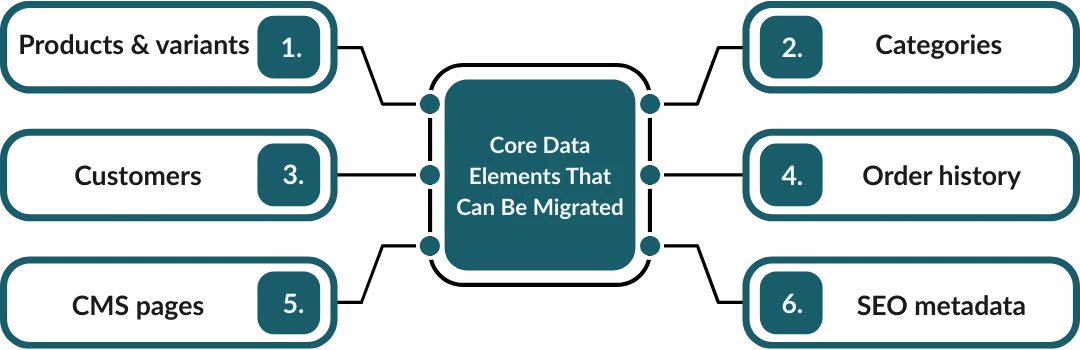
Core Data Elements That Can Be Migrated
Most of the foundational store data can be moved relatively seamlessly:
- Products & variants – SKU, descriptions, pricing, and inventory levels
- Categories – Hierarchical category structures for navigation and filtering
- Customers – Account information, addresses, and segmentation data
- Order history – Past orders, invoices, and transaction records
- CMS pages – Informational pages, landing pages, and blog content
- SEO metadata – Page titles, meta descriptions, H1s, and alt tags
Data That Requires Re‑Engineering
Certain elements require customization or strategic adjustments due to differences in platform architecture:
- Custom attributes – Magento’s flexible attribute sets may not map 1:1 to BigCommerce; some reconfiguration is required.
- Complex pricing rules – Tiered pricing, wholesale discounts, and promotional rules may need to be rebuilt in BigCommerce’s pricing engine.
- Third-party extensions – Plugins for shipping, payments, or marketing often require replacement with BigCommerce-native apps or custom integrations.
- Custom checkout logic – Any bespoke checkout workflows in Magento will need redevelopment within BigCommerce’s checkout framework.
This is precisely where platform expertise outweighs tools. Experienced migration teams can anticipate pitfalls, re-engineer data intelligently, and ensure a smooth transition without losing critical business functionality.
Custom attributes
Magento’s flexible attribute sets may not map 1:1 to BigCommerce; some reconfiguration is required.
Complex pricing rules
Tiered pricing, wholesale discounts, and promotional rules may need to be rebuilt in BigCommerce’s pricing engine.
Third-party extensions
Plugins for shipping, payments, or marketing often require replacement with BigCommerce-native apps or custom integrations.
Custom checkout logic
Any bespoke checkout workflows in Magento will need redevelopment within BigCommerce’s checkout framework.
This is precisely where platform expertise outweighs tools. Experienced migration teams can anticipate pitfalls, re-engineer data intelligently, and ensure a smooth transition without losing critical business functionality.
B2B Commerce: Is BigCommerce Ready in 2026?
Short answer: Yes—but the approach is different than Magento.
Magento B2B Strengths
Magento has long been the go-to for B2B merchants who require:
- Highly customizable workflows for complex business processes
- Deep ERP-driven pricing logic for tiered pricing, volume discounts, and account-specific agreements
- Advanced quote and approval workflows embedded into the platform
These capabilities make Magento ideal for businesses where backend control and flexibility outweigh operational simplicity.
BigCommerce B2B Strengths
BigCommerce has evolved into a robust B2B SaaS platform, with features that focus on buyer experience:
- Native B2B Edition with tools built specifically for wholesale and multi-account operations
- Customer groups and price lists to manage tiered pricing without complex custom coding
- Shared shopping lists to streamline repeat orders for business buyers
- Quote workflows via APIs that integrate seamlessly with external CRM and ERP systems
- Faster buyer experience, reducing friction in ordering and checkout
Key Difference: BigCommerce prioritizes front-end efficiency and scalability, while Magento emphasizes backend control and customization. The best choice depends on whether your business values operational flexibility or a streamlined buyer experience more.
Performance: The Silent Migration Win
Performance is often an afterthought during migration conversations, but it frequently becomes the most visible benefit post-launch.
BigCommerce delivers:
- Global CDN for faster content delivery anywhere in the world
- Automatic scaling during traffic spikes or seasonal promotions
- Consistent uptime with minimal intervention
Magento performance depends on:
- Hosting quality and server optimization
- Ongoing developer involvement to tune caching and speed
- Continuous monitoring and emergency interventions
In 2026, performance is no longer optional—it’s a baseline expectation. Merchants that migrate to BigCommerce often see immediate improvements in site speed, checkout reliability, and customer satisfaction.
When NOT to Migrate from Magento to BigCommerce
Balanced guidance is essential to build trust—and Google rewards content that helps readers make informed decisions. Migration may not be the right move if your business relies heavily on:
1. Heavy Backend Customizations
- Deeply custom order logic or ERP-specific workflows
- Highly specialized checkout flows
In such cases, BigCommerce may require re-architecture or workarounds, making migration less practical.
2. Highly Bespoke Workflows
- Processes tightly coupled to Magento’s backend logic may experience friction if forced onto a SaaS platform.
3. Platform Lock-In Scenarios
- Businesses deeply embedded in Adobe Commerce + Experience Cloud
- Heavy reliance on Adobe-native integrations
In these situations, optimization rather than migration may deliver better ROI.
BigCommerce Migration from Magento: A Practical Roadmap
A successful migration is not a single event—it’s a controlled, multi-phase transition. A practical roadmap includes:
- Platform & data audit – Assess Magento customizations, data quality, and integration points
- SEO mapping – Preserve organic traffic with URL mapping, redirects, and metadata alignment
- B2B requirement validation – Confirm pricing logic, quotes, and account-specific features on BigCommerce
- ERP & third-party integration planning – Identify tools that must migrate or integrate
- Data migration & QA – Move products, customers, orders, and content with validation
- Parallel SEO testing – Ensure search visibility is retained during rollout
- Phased go-live – Launch incrementally to minimize disruption
Why Partner Experience Matters More Than the Platform
Migration fails not because of technology, but because of execution. At DotcomWeavers, we approach Magento to BigCommerce migration services as a business transformation project, not just a platform switch. Our expertise includes:
- End-to-end Magento and BigCommerce migrations for B2B and B2C brands
- Deep experience with ERP, PIM, and third-party integrations
- Data strategy planning and execution that protects business continuity
- SEO and performance-focused migrations to preserve revenue and rankings
With DCW, a preferred BigCommerce partner, brands don’t just move platforms—they gain operational confidence, reduced overhead, and scalable growth potential. Our teams ensure that your migration is smooth, secure, and designed to unlock the full value of BigCommerce.
Final Thoughts: Is Moving from Magento to BigCommerce Right for You?
Magento is not obsolete—but for many brands in 2026, it is over-engineered for what they truly need. If your priorities are:
- Speed to market
- Predictable costs
- Scalable performance
- Reduced operational overhead
…then migrating from Magento to BigCommerce is not just a technical move—it’s a strategic business decision.
When executed correctly, it doesn’t feel like change—it feels like relief. And with DotcomWeavers guiding the process, brands can migrate confidently, safeguard SEO and data, streamline B2B operations, and focus on growth rather than maintenance.
About the Author: Karan

Receive a Personalized Consultation for Your eCommerce Requirements!
Receive a Personalized Consultation for Your eCommerce Requirements!