

Order management in B2B commerce is far more complex than in B2C. Manufacturers, distributors, and wholesalers deal with large-volume purchases, tiered pricing, negotiated contracts, and customer-specific terms. Orders often arrive through multiple channels—email, Excel, PDFs, EDI, or phone—each requiring manual processing and validation. These fragmented workflows create inefficiencies, from data entry errors and inventory mismatches to fulfillment delays and increased operational costs.
Even with modern eCommerce platforms like Adobe Commerce (Magento) or BigCommerce, the lack of real-time connectivity with backend systems like ERPs makes it difficult to streamline operations. Teams spend valuable time reconciling orders across platforms, verifying product availability, applying pricing rules, and pushing data into siloed systems. As order volumes scale, so do the bottlenecks.
This is where AI-powered order management comes in—automating everything from order capture and validation to fulfillment and ERP synchronization. It enables B2B companies to reduce manual effort, eliminate errors, accelerate turnaround times, and build more resilient, scalable workflows.
In this blog, we’ll explore how AI-driven order management transforms B2B commerce, the operational advantages it brings, and how companies using Adobe Commerce or BigCommerce can integrate it effectively into their ecosystem.
- The Hidden Cost of Manual Order Management
- Enter AI-Powered Order Management
- Core Capabilities of AI in Order Management
- How Manufacturers with Complex Catalogs Use AI to Cut Order Time?
- AI Advantage for Distributors: Smarter Multi-Warehouse Fulfillment
- The Power of AI + ERP Integration in B2B Workflows
- From Operational Efficiency to Customer Loyalty: How AI Streamlines Experience Inside and Out
- The Road to AI Order Automation: A Phased Approach
- The ROI of AI Order Management
- Beyond Efficiency: Strategic Advantage
- Key Considerations When Choosing an AI System
- Why DotcomWeavers: Your Partner in Smart B2B Order Management
Let’s dive deeper into every aspect to give you a complete picture.
The Hidden Cost of Manual Order Management
At first glance, order processing may seem like a routine administrative task—but in a B2B environment, it’s anything but simple. Behind every purchase order is a complex chain of actions that requires accuracy, speed, and coordination between departments. When handled manually, even minor missteps can snowball into major disruptions.
Operations managers often spend hours verifying customer-specific pricing, stock availability, and fulfillment timelines. Any discrepancies—whether due to outdated spreadsheets or miscommunications—require manual intervention, slowing down the process and diverting attention from higher-priority tasks.
Meanwhile, customer service teams are left firefighting: chasing down missing order details, fielding calls about incorrect shipments, and managing returns caused by errors in data entry or fulfillment. This reactive approach erodes customer trust and places undue pressure on teams already stretched thin.
IT teams face their own challenges, maintaining fragile integrations between ERP systems, CRMs, and eCommerce platforms. Without a streamlined flow of order data, errors multiply and system silos deepen—impacting visibility, traceability, and overall efficiency.
These issues can result in:
| >Delayed order fulfillment | >Frustrated customers and lost loyalty |
| >Frequent inventory mismatches | >Higher operating cost due to order errors and returns |
When a single order touches multiple systems and teams, any lack of synchronization can trigger a chain reaction—disrupting not just operations but also cash flow and customer satisfaction. In today’s fast-moving B2B landscape, this level of inefficiency is not just costly—it’s a competitive liability.
Enter AI-Powered Order Management
AI-powered order management systems are purpose-built to solve the operational pain points that traditional B2B workflows can’t. By leveraging artificial intelligence and machine learning, these systems go far beyond simple automation—they intelligently ingest, validate, route, and track orders across complex, multi-system environments.
Where traditional rule-based systems require predefined logic and often break down when exceptions occur, AI adapts. It learns from historical data, understands context, and applies pattern recognition to streamline processes that were previously manual, repetitive, and error-prone.
One of the biggest advantages of AI-driven order management is its ability to work with unstructured data, like emails, PDFs, Excel sheets, or even messages from customer portals. AI can extract order details from these formats, standardize the information, and push it directly into your ERP or OMS without human intervention.
Whether it’s applying customer-specific pricing, checking product availability in real time, validating payment terms, or flagging discrepancies, AI systems can make these decisions dynamically and accurately. They continuously learn from every transaction, improving with time and reducing the need for manual reviews.
For B2B companies managing large catalogs, high order volumes, and multiple customer segments, this level of intelligence isn’t just helpful, it’s essential. AI makes the entire order lifecycle more agile, scalable, and resilient, allowing businesses to serve customers faster, more accurately, and with far fewer resources.
Core Capabilities of AI in Order Management
AI-powered order management systems aren’t just about automation—they’re about intelligence at every stage of the order lifecycle. From the moment an order is received to final delivery, AI optimizes each step for speed, accuracy, and efficiency. Below are the key capabilities that set AI apart from traditional rule-based systems:
How Manufacturers with Complex Catalogs Use AI to Cut Order Time?
For manufacturers dealing with extensive product catalogs and a large dealer network, order management can quickly become a logistical nightmare. Imagine a business with 10,000+ SKUs and over 300 dealers spread across the country—each with unique pricing agreements, discount tiers, and payment terms. Orders arrive daily through various channels: Excel sheets, PDFs, EDI feeds, or even handwritten scanned forms.
Each order must be carefully interpreted, validated, and entered manually into the ERP system—a process that takes hours per order, especially when the format or customer details deviate even slightly.
AI-powered order management systems completely transform this scenario.
With intelligent automation, the system can:
- Extract order data regardless of format or source using OCR and NLP
- Recognize the customer and apply correct contract terms, discounts, and pricing
- Verify inventory availability in real time against multiple warehouse locations
- Select the best fulfillment route based on geography, shipping windows, and order size
- Trigger downstream actions automatically—like order confirmation, invoice generation, and ERP updates
What once required hours of manual coordination can now be completed within minutes, with far fewer errors—even during peak season or high-demand periods.
For manufacturers with high SKU complexity, AI doesn’t just improve order accuracy—it makes growth operationally sustainable.
AI Advantage for Distributors: Smarter Multi-Warehouse Fulfillment
For B2B distributors managing multiple warehouses across regions, fulfillment isn’t just about speed—it’s about optimization. Consider a distributor in the construction materials space, operating four warehouses across the country. Daily orders come in from contractors, wholesalers, and retailers, all expecting quick, cost-effective delivery.
Traditionally, routing these orders involves manual checks: Which warehouse has stock? Which is closest to the delivery point? Can it meet the promised ship date? Human-led processes struggle with this in real time—especially as order volumes scale.
Here’s where AI-powered order management creates a meaningful shift.
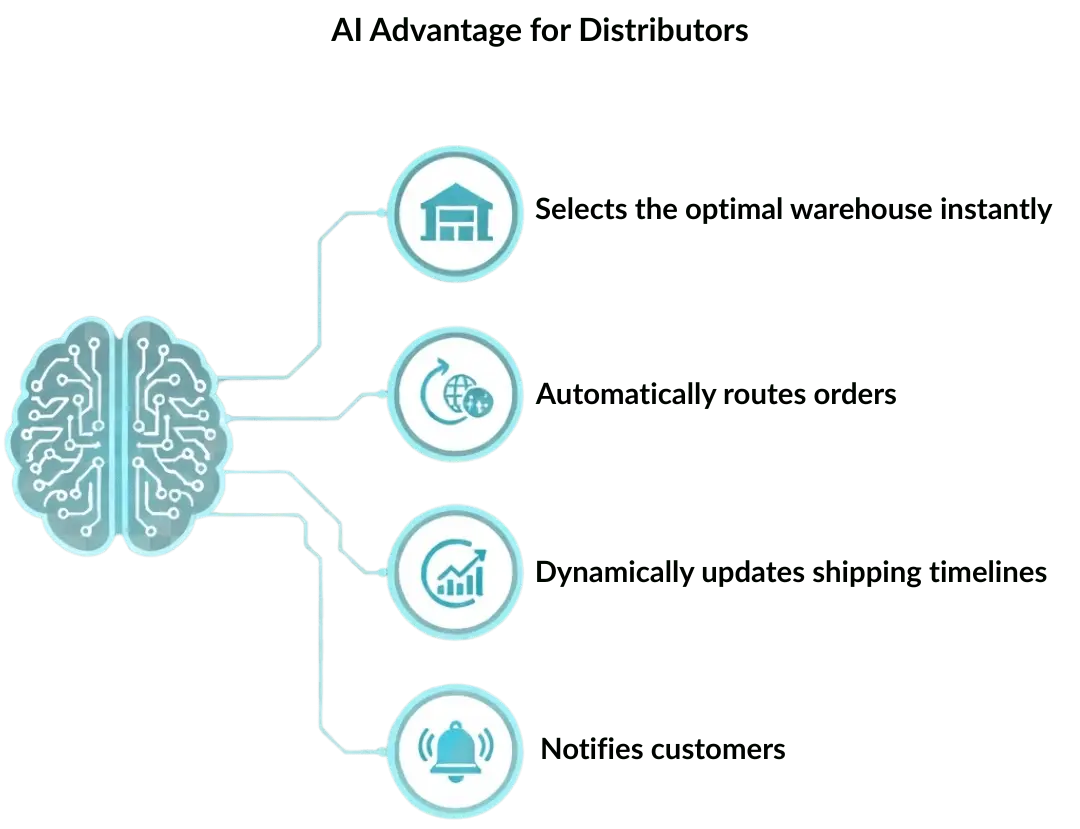
With AI, the system:
- Selects the optimal warehouse instantly, based on proximity, inventory, and service level agreements
- Automatically routes orders to the right fulfillment center without human intervention
- Dynamically updates shipping timelines, factoring in carrier performance, lead times, and customer urgency
- Notifies customers with real-time updates on shipping status and estimated delivery windows
This level of automation leads to faster fulfillment, lower shipping costs, and higher customer satisfaction—especially in industries where delivery speed and accuracy impact ongoing projects or supply chains.
For distributors, AI eliminates the guesswork and manual juggling, enabling leaner teams to manage more orders with greater precision.
The Power of AI + ERP Integration in B2B Workflows
AI-powered order management delivers its highest value when tightly integrated with your ERP system. While AI can automate key steps like order capture, validation, and fulfillment logic on its own, its true strength lies in connecting every part of the workflow—across eCommerce platforms, inventory systems, pricing engines, shipping, and accounting tools.
For B2B companies using platforms like Adobe Commerce (Magento) or BigCommerce, integrating AI with backend ERP systems enhances operations without requiring a full replatforming. Instead, it creates a seamless, intelligent bridge between customer-facing transactions and backend execution.
This is especially valuable for companies running complex ERP environments such as:
- Epicor Suite: Eclipse, Prophet 21 (P21), Eagle, BisTrack, and Kinetic
- NetSuite
- Infor
When paired with AI, these systems can unlock:
Real-Time Inventory Syncronization
Prevent stockouts or overselling with accurate, up-to-date inventory pulled directly from your ERP and reflected across all channels.
Centralized Financial Reconciliation
Every transaction is logged in the ERP with correct tax, discount, and freight charges—ensuring financial accuracy and audit readiness.
Dynamic Pricing and Quote Generation
AI references real-time ERP pricing rules and customer-specific contracts to generate accurate quotes and apply negotiated rates automatically.
Automated Fulfillment and Shipping
Orders are instantly routed to the optimal warehouse based on ERP stock data, and shipping labels or tracking are triggered automatically—minimizing human touchpoints.
At DotcomWeavers, we specialize in implementing these AI-driven solutions with seamless integration across platforms like Adobe Commerce, Magento Open Source, BigCommerce, and Shopify Plus—alongside ERP systems such as Epicor, NetSuite, and Infor. Our end-to-end services ensure your tech stack works in harmony, unlocking efficiency across the entire order-to-cash cycle.
From Operational Efficiency to Customer Loyalty: How AI Streamlines Experience Inside and Out
AI-powered order management doesn’t just improve backend workflows—it has a direct and measurable impact on customer experience and satisfaction. By reducing friction throughout the order lifecycle and automating critical touchpoints, AI helps B2B companies deliver faster, smarter, and more reliable service.
Here’s how AI drives value across both customer-facing and internal operations:
Enhanced Customer Experience That Builds Loyalty
In B2B relationships, repeat business depends heavily on consistency, transparency, and responsiveness. AI helps brands meet those expectations by turning every order into a smooth, predictable interaction. Key improvements include:
- Faster Order Confirmations
AI reduces lag time between when an order is placed and when confirmation is sent. This gives customers instant peace of mind and eliminates the uncertainty common in manually processed orders.
- Accurate Inventory Visibility
With real-time ERP integration, customers are only shown what’s available. AI ensures that product availability is up to date, reducing canceled orders and backorders.
- Predictable Delivery Timelines
AI dynamically selects warehouses and carriers, accounting for fulfillment capacity and geography. As a result, delivery estimates are more accurate and consistent—improving customer trust.
- Fewer Pricing and Fulfillment Errors
AI auto-applies customer-specific terms, discounts, and conditions—dramatically reducing the kinds of pricing or fulfillment errors that lead to disputes or returns.
Together, these improvements help B2B companies build stronger customer relationships, increase retention, and unlock larger contract opportunities. In high-value sales cycles, experience is just as important as price—and AI helps you deliver on both.
Intelligent Workflow Automation That Frees Your Team
On the operational side, AI doesn’t just automate order entry—it automates decisions. It understands business rules, learns from patterns, and routes orders or exceptions to the right team or person based on context. This eliminates the bottlenecks caused by manual approvals or unclear responsibilities. Examples include:
- Credit Limit Escalations
When an order exceeds a customer’s credit limit, AI automatically flags and forwards it to the finance team for approval—complete with contextual data like payment history and outstanding balances.
- Backorder Management
If an item is out of stock, AI can immediately trigger an alert, suggest an in-stock substitute, or split the shipment—all without human intervention. This keeps orders moving and reduces delays.
- High-Value Transaction Routing
Large or sensitive orders—based on value, geography, or customer status—can be escalated to sales or operations managers for final review before processing, ensuring accountability and risk control.
Because these workflows are automated and rule-based, your team spends less time reacting and more time focusing on strategic priorities. It also helps enforce compliance, reduce approval delays, and maintain a consistent internal process—even as your business scales.
In short, AI doesn’t just improve what happens behind the scenes—it elevates the entire B2B experience. When internal teams are empowered and customers are better served, everyone wins.
The Road to AI Order Automation: A Phased Approach
Adopting AI in order management doesn’t require a full rip-and-replace. A phased approach works best:
- Phase 1: Identify high-friction areas: Start with the biggest pain point—usually manual order capture or validation.
- Phase 2: Implement AI-powered tools: Choose the best tools for eCommerce ERP integration
- Phase 3: Automate internal workflows: Define rules for approvals, routing, and exception handling.
- Phase 4: Expand across departments: Bring in forecasting, customer service automation, and analytics.
The ROI of AI Order Management
AI-powered order management isn’t just about automation; it’s about real operational gains that translate into tangible cost savings, efficiency improvements, and long-term scalability. For B2B organizations managing hundreds (or thousands) of orders per month, these efficiencies compound quickly.
| Metric | Manual Process | With AI | Impact |
|---|---|---|---|
| Order Processing Time | 30–45 minutes/order | 3–5 minutes/order | ~90% reduction in time per order |
| Error Rate | 5-10% | <1% | Fewer returns, chargebacks, and rework |
| Staff Involvement | 2–3 people/order | 0–1 person/order | Frees up team capacity for higher-value tasks |
| Fullfillment Accuracy | ~90% | 98-99% | Higher customer satisfaction and retention |
| Cost Per Order | $15–25 | $5–8 | 2–3x reduction in processing cost |
Beyond Efficiency: Strategic Advantage
While operational efficiency is the immediate win, AI order management also provides long-term strategic value:
- Scalability without hiring sprees
- Faster onboarding of new customers or regions
- Real-time analytics and performance insights
- Agile adaptation to supply chain disruptions
In an uncertain global market, that flexibility can be the difference between surviving and thriving.
Key Considerations When Choosing an AI System
When evaluating AI order management software, look for:
- ERP compatibility
- Support for unstructured input formats
- Custom workflow automation
- Role-based access control
- Built-in analytics and audit trails
- Scalability across channels and geographies
And most importantly, ensure the vendor understands the nuances of B2B eCommerce.
To Conclude, The Future Is (Intelligently) Touchless
The future of B2B order management is touchless—not because people are being replaced, but because their time is too valuable to be spent on repetitive, error-prone tasks like manual data entry, pricing validation, or order routing.
AI allows your teams to focus on what really moves the needle: building customer relationships, optimizing fulfillment strategies, and scaling your business intelligently.
Touchless doesn’t mean impersonal. It means smarter, faster, and more customer-centric.
Why DotcomWeavers: Your Partner in Smart B2B Order Management
At DotcomWeavers, we understand that AI isn’t just another technology buzzword—it’s a tool to solve real operational challenges that B2B companies face every day.
Whether you’re a manufacturer managing tens of thousands of SKUs or a distributor juggling multi-warehouse fulfillment, we help design solutions that work for your specific use case. Our strength lies in building AI-powered ecosystems—not just deploying software—that connect your eCommerce platform, ERP, and backend workflows into one intelligent, seamless operation.
Our core capabilities include:
- Adobe Commerce & Magento B2B Development: Customized, scalable commerce solutions built for complex B2B needs.
- Custom ERP Integration Services: Deep expertise across platforms like Epicor (Eclipse, P21, Eagle, BisTrack, Kinetic), NetSuite, and Infor.
- Workflow Automation & AI Consulting: From intelligent order capture to exception handling, we help you unlock the full potential of AI in your operations.
We work with platforms like BigCommerce, Shopify Plus, and Magento Open Source, ensuring flexibility based on your tech stack and business goals.
Ready to Explore AI for Your Order Management?
If you’re looking to:
- Invest in a B2B order automation solution
- Choose the right order management software for manufacturers or distributors
- Partner with experts who can craft a custom roadmap to AI adoption
Then let’s talk.
DotcomWeavers is here to help you turn complexity into clarity—and manual into intelligent.
Let’s build something smarter, together.
About the Author: Amit Bhaiya

Receive a Personalized Consultation for Your eCommerce Requirements!
Receive a Personalized Consultation for Your eCommerce Requirements!