
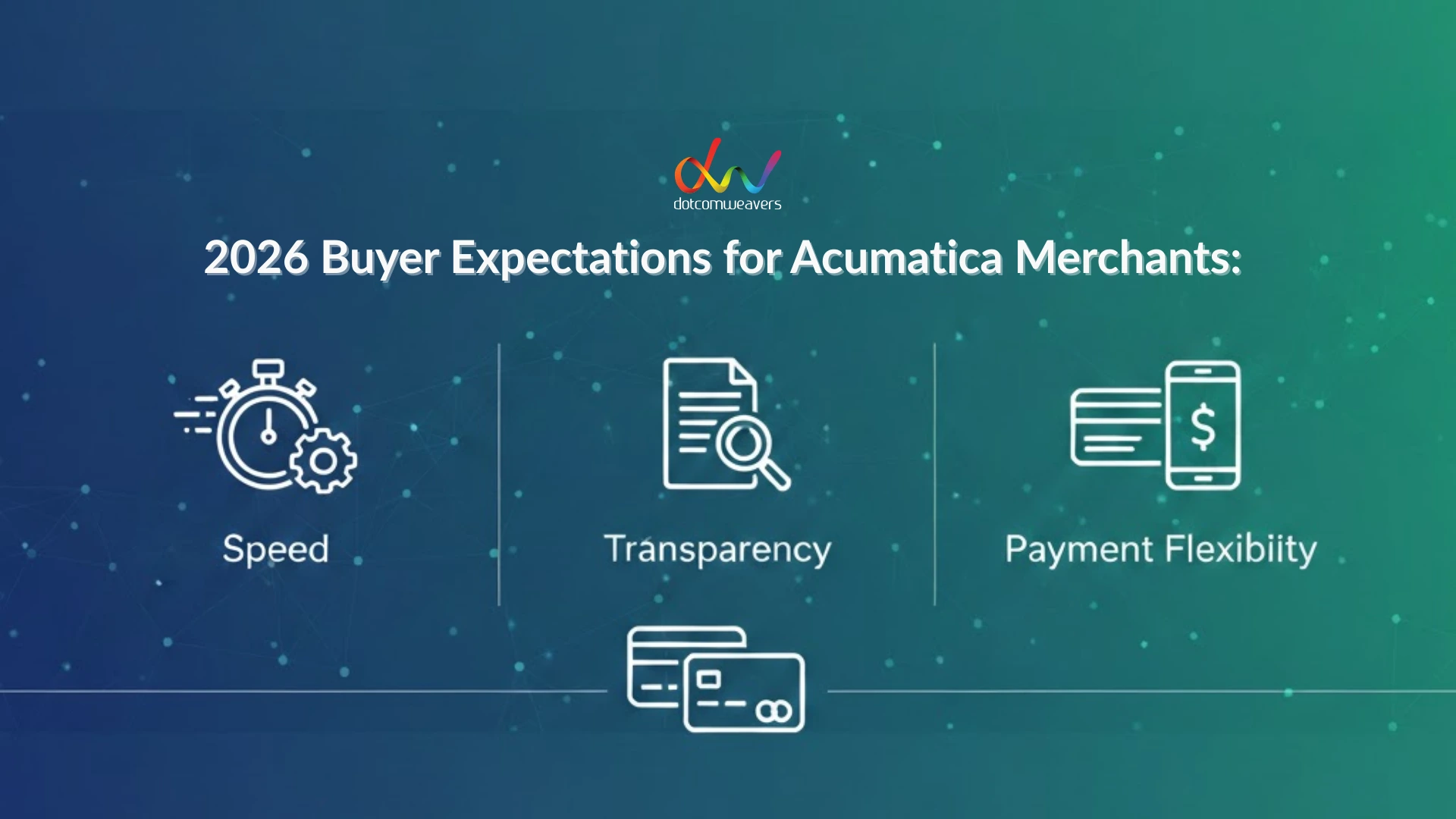
Buyer expectations in 2026 are the result of a long shift, not a sudden change. Years of digital maturity, widespread automation, and exposure to consumer-grade buying experiences have permanently reshaped how buyers evaluate vendors, especially in B2B. Today’s buyers compare every purchasing experience against the best ones they’ve had, regardless of industry. If a process feels slow, unclear, or rigid, they don’t wait for it to improve—they move on.
Whether it’s a procurement manager placing a six-figure replenishment order or an end customer completing a repeat purchase, the underlying expectation is the same: buying should be fast, predictable, and flexible. Speed is no longer about convenience; it’s about operational confidence. Transparency is no longer a differentiator; it’s a prerequisite for trust. And payment flexibility is no longer optional; it directly influences whether a transaction is completed at all.
For businesses running on Acumatica, these expectations have very real consequences. They affect conversion rates, order accuracy, days sales outstanding, support workload, and customer retention. Gaps between systems, manual workarounds, or rigid payment processes are no longer internal issues, they are visible to buyers and reflected in their purchasing decisions.
This blog examines what buyers expect from Acumatica merchants in 2026, why those expectations exist, and how they translate into concrete operational requirements. The focus is not on trends or buzzwords, but on execution, how speed, transparency, and payment flexibility must be designed into the Acumatica ecosystem to support modern buyer behavior at scale.
1. The 2026 Buyer Mindset: What Has Fundamentally Changed
The most significant shift in buyer behavior is not driven by new technology, it is driven by buyer confidence and leverage. Buyers today are better informed, more self-directed, and far less dependent on vendor guidance than in the past. Access to real-time data, peer reviews, competitor benchmarks, and digital purchasing tools has fundamentally changed how buyers evaluate vendors and make decisions.
In 2026, buyers assume that modern systems are in place. When experiences fall short, they attribute the failure not to limitations, but to operational inefficiency or lack of investment. As a result, tolerance for friction is extremely low, and switching costs, both perceived and real, continue to decline.
Three forces now define the 2026 buyer mindset:
2. Speed Is No Longer About Performance Alone
In 2026, speed is no longer measured by page load times or technical benchmarks alone. Buyers evaluate speed across the entire transaction lifecycle—from the moment they begin searching for a product to the point where payment is confirmed and fulfillment is underway. Any delay along this path is perceived as friction, regardless of where it occurs in the system.
What has changed is that buyers now see speed as a proxy for operational maturity. A slow response, delayed confirmation, or unclear status suggests internal inefficiencies that could surface again later in the relationship.
Where Buyers Measure Speed
Buyers assess speed at several critical stages:
- Product discovery: Buyers expect to locate relevant SKUs, configurations, pricing, and availability quickly. Slow search, outdated inventory, or unclear pricing immediately raises doubts about data accuracy and fulfillment reliability.
- Checkout: Buyers are highly sensitive to unnecessary steps. Extra approvals, forced account creation, redirects to external systems, or delayed validation all increase abandonment risk—especially for repeat purchases.
- Order processing: Once an order is placed, buyers expect it to move immediately into fulfillment. Orders that sit in review queues, require manual intervention, or wait on internal approvals create uncertainty and slow downstream operations.
- Payment confirmation: Payment status must be visible immediately. Buyers expect instant confirmation that funds were authorized and applied correctly. Delayed or unclear payment confirmation creates follow-up work and undermines trust.
A fast storefront alone does not meet these expectations. If orders stall internally, payments require manual reconciliation, or confirmations are delayed, buyers experience the entire transaction as slow, regardless of frontend performance.
How Acumatica Supports Transaction Speed
Acumatica is well-suited to support transaction speed because of its unified data model and real-time processing capabilities. When implemented with discipline, it enables:
- Real-time inventory availability across sales channels
- Automated order validation and pricing enforcement
- Immediate financial posting upon order and payment completion
- Integrated payment processing within core workflows
These capabilities reduce handoffs, eliminate duplicate data entry, and allow transactions to move through the system without interruption.
However, speed is highly sensitive to configuration. Custom workflows layered on without clear justification, disconnected payment gateways, or manual approval steps can quickly erode performance. In many cases, the platform is capable of faster execution than the business allows.
To meet buyer expectations in 2026, Acumatica merchants must focus on reducing internal latency, the delays created by process design, integration gaps, and manual intervention. Frontend optimization matters, but true speed is achieved only when backend systems, payments, and fulfillment workflows move at the same pace as the buyer.
3. Transparency as a Trust Requirement, Not a Feature
In 2026, transparency is not viewed as an added benefit; it is a baseline expectation. Buyers assume that accurate, real-time information should be available at every stage of the transaction. When information is missing, delayed, or inconsistent, buyers interpret it as a signal of weak internal controls or fragmented systems.
This lack of visibility does more than create frustration. It introduces risk into the buying decision. Buyers slow down, seek validation, or disengage entirely because uncertainty increases their internal cost of doing business with a vendor.
Transparency is now expected across four core areas of the buying experience:
Pricing
Buyers expect pricing to be clear, predictable, and aligned with their agreements. This includes visibility into contract pricing, volume tiers, discounts, taxes, and fees before checkout. Any pricing discrepancy discovered late in the process undermines confidence and often results in abandoned transactions or post-order disputes.
Inventory
Accurate, real-time inventory visibility is critical. Buyers rely on availability data to plan purchasing, production, or resale. When stock information is outdated or unreliable, buyers compensate by ordering conservatively, requesting confirmations, or choosing alternative vendors with clearer availability signals.
Fulfillment
Buyers expect realistic delivery timelines and ongoing visibility into order status. Estimated delivery dates that change after checkout, or a lack of shipment tracking, create downstream planning issues for buyers and generate unnecessary follow-up communication.
Financials
Visibility into invoices, credits, and payment status is essential, particularly for B2B buyers managing cash flow and internal approvals. Buyers expect to see when invoices are issued, how payments are applied, and whether balances are current without needing to contact support.
Why Transparency Directly Impacts Revenue
When buyers do not have clear information, they compensate in predictable ways:
- Abandoning carts due to uncertainty or late-stage surprises
- Delaying internal approvals while seeking clarification
- Contacting support teams for confirmation or documentation
- Requesting manual intervention for pricing, fulfillment, or payments
Each of these behaviors increases operational cost, slows the sales cycle, and reduces conversion rates. Over time, repeated friction erodes trust and shifts buyers toward vendors that offer clearer, more predictable experiences.
For Acumatica merchants, transparency is an execution challenge, not a communication one. It requires ensuring that ERP data, pricing rules, inventory levels, tax calculations, fulfillment status, and financial records are accurate and consistently surfaced across all buyer-facing touchpoints. When systems are aligned, transparency becomes automatic, and trust becomes a byproduct of reliable execution.
4. Payment Flexibility Is a Core Buying Criterion
In 2026, payment flexibility directly influences whether a transaction is completed. Buyers do not adapt to merchant limitations, they choose vendors that support their preferred payment methods.
Payment expectations vary by buyer type but share a common theme: choice without complexity.
Common Buyer Payment Expectations
- Multiple payment methods (credit card, ACH, stored payment methods)
- Fast authorization without redirects
- Secure storage for repeat purchases
- Clear linkage between payments, invoices, and orders
For B2B buyers, payment flexibility often includes:
- ACH and bank payments
- Level II and Level III card processing
- Support for partial payments or deposits
- Clean reconciliation with invoices
5. The Role of EBizcharge in the Acumatica Payment Stack
EBizcharge is a payment processing solution that integrates directly with Acumatica, designed to reduce friction between ordering, invoicing, and payment.
Rather than operating as a disconnected gateway, EBizcharge embeds payment functionality inside Acumatica workflows, allowing merchants to:
- Accept multiple payment types within the ERP
- Process payments in real time
- Automatically apply payments to invoices
- Reduce manual reconciliation
This matters because payment delays and errors are among the most common causes of buyer dissatisfaction.
By keeping payment data synchronized with Acumatica, merchants can provide buyers with immediate confirmation and accurate financial visibility.
6. One View of the Buyer Experience
The table below summarizes how speed, transparency, and payment flexibility intersect across the buyer journey.
| Buyer Touchpoint | 2026 Buyer Expectation | Operational Requirement in Acumatica |
|---|---|---|
| Product Selection | Accurate pricing and availability | Real-time pricing and inventory sync |
| Checkout | Minimal steps, fast processing | Streamlined workflows and integrated payments |
| Payment | Choice, security, confirmation | Multi-method processing via tools like EBizCharge |
| Fulfillment | Predictable delivery | ERP-driven logistics visibility |
| Post-Purchase | Clear invoices and payment status | Automated posting and reporting |
7. Reducing Checkout and Payment Friction
In 2026, checkout friction is rarely caused by poor interface design alone. In most cases, it originates in backend inefficiencies, disconnected systems, manual handoffs, and payment workflows that are not fully integrated with core financial operations. Buyers experience these issues as delays, uncertainty, or unnecessary steps, even when the frontend appears polished.
Common Sources of Checkout and Payment Friction
- Redirecting users to external payment portals breaks the buying flow and introduces uncertainty, especially for repeat or high-value transactions.
- Delayed payment confirmation creates ambiguity around order status and often triggers follow-up inquiries or duplicate actions.
- Manual invoice matching slows down both buyer and merchant processes, increasing the likelihood of errors and disputes.
- Inconsistent payment status across systems forces buyers and internal teams to rely on manual verification instead of real-time data.
Each of these issues extends the transaction lifecycle and increases operational cost, even if the order is ultimately completed.
Reducing Friction Through System Design
Acumatica merchants can significantly reduce friction by aligning payment execution with core ERP workflows. This includes:
- Using native or tightly integrated payment solutions that operate directly within Acumatica rather than alongside it
- Supporting stored payment methods for repeat buyers to eliminate redundant data entry
- Automating the invoice-to-payment application so financial records remain accurate without manual intervention
- Eliminating redundant approval steps that do not add risk control but slow execution
Integrated payment tools such as EBizcharge help collapse multiple steps, authorization, posting, reconciliation, and reporting into a single, traceable transaction flow. The result is faster checkout for buyers and cleaner financial operations for merchants.
8. Security Expectations Without Added Friction
Buyers in 2026 assume that security is built in. They expect strong protections, but they do not want those protections to interrupt the purchasing process. Any security measure that adds visible friction is often perceived as poor system design rather than necessary risk management.
Baseline Security Expectations in 2026
Buyers expect the following as standard:
- PCI-compliant payment processing across all payment methods
- Tokenization of stored payment methods to protect sensitive data
- Clear indicators of secure checkout, especially for high-value transactions
- Minimal exposure of sensitive information, with no unnecessary data entry or storage
Security failures or inconsistencies immediately undermine trust, particularly in B2B environments where financial controls and compliance matter.
Designing Security at the System Level
For Acumatica merchants, meeting these expectations means avoiding custom or manual handling of payment data and relying instead on compliant, purpose-built payment processors. When security is handled at the system level, through tokenization, controlled access, and automated compliance, buyers gain confidence without being asked to take extra steps.
This approach reduces risk while preserving speed and usability, which are equally critical to buyer satisfaction.
9. B2B Buyer Expectations Are Converging, Not Disappearing
B2B transactions in 2026 remain inherently more complex than B2C transactions. Contract pricing, approvals, credit terms, and negotiated payment structures are still essential. What has changed is who is expected to manage that complexity.
Buyers no longer accept complexity as a reason for poor usability or limited visibility. They expect systems to absorb complexity so that purchasing remains efficient and predictable.
What Buyers Now Expect in B2B Transactions
- Clear visibility into contract and customer-specific pricing
- Predictable approval workflows that do not delay execution
- Flexible payment options aligned with negotiated terms
- Real-time visibility into orders, invoices, and payments
Acumatica supports these expectations through:
- Role-based access that aligns with buyer and approver responsibilities
- Customer-specific pricing and contract enforcement
- Integrated financial workflows that connect ordering, invoicing, and payment
When these capabilities are paired with flexible, integrated payment solutions, merchants can support both the structural complexity of B2B transactions and the usability standards buyers now expect. The result is a buying experience that feels efficient rather than burdensome—without sacrificing control or compliance.
10. Measuring What Buyers Experience
To improve buyer experience, merchants must measure it operationally—not just through surveys.
Key indicators include:
| Metric | Why It Matters |
|---|---|
| Order Processing Time | Reveals internal bottlenecks |
| Payment Authorization Time | Indicates checkout friction |
| Payment Error Rate | Signals integration or workflow issues |
| Support Tickets per Order | Reflects transparency gaps |
| Repeat Purchase Rate | Measures buyer trust |
Acumatica’s reporting capabilities, combined with payment data from solutions like EBizcharge, allow merchants to track these metrics with precision.
11. Preparing for What Comes After 2026
While buyer expectations will continue to evolve, the direction of change is no longer uncertain. What changes over time are the tools and channels buyers use, not the principles that guide their decisions. Speed, transparency, and control will remain the foundation of buyer trust well beyond 2026.
The merchants that adapt most effectively are not those chasing every new capability, but those building systems that can absorb change without disruption.
Three principles will continue to define buyer expectations going forward:
Faster Execution
Buyers will continue to expect transactions to move with minimal delay across every stage of the lifecycle. As automation, AI-assisted purchasing, and real-time data become more common, tolerance for manual intervention will decline further. Any process that requires human follow-up, re-entry of data, or offline confirmation will stand out as inefficient. Merchants that design workflows for straight-through processing will be better positioned to scale without adding operational overhead.
Clearer, More Immediate Information
Buyers will expect information to be available instantly and consistently, regardless of channel. As procurement systems, marketplaces, and integrated purchasing tools become more interconnected, discrepancies in pricing, availability, or order status will be harder to justify. Transparency will increasingly be evaluated system-to-system, not just user-to-interface. Merchants that rely on unified, real-time data will be able to meet these expectations without additional complexity.
Greater Control for the Buyer
Buyers will continue to seek control over how they purchase, pay, and manage their transactions. This includes control over payment methods, visibility into financial status, and flexibility in how and when they interact with vendors. Rigid processes will increasingly push buyers toward alternatives that offer more autonomy without sacrificing reliability.
For Acumatica merchants, preparing for what comes after 2026 is less about predicting specific technologies and more about architectural readiness. Systems should be modular, well-integrated, and designed to support change without rework, whether that change involves new payment methods, AI-driven purchasing workflows, expanded sales channels, or evolving compliance requirements.
Execution Is the New Differentiator
In 2026, buyer expectations are no longer aspirational goals; they are operational requirements. Speed, transparency, and payment flexibility directly influence whether buyers complete transactions, how quickly cash is collected, and whether customers return. These expectations are shaped by daily experiences with efficient, data-driven platforms, and buyers bring those standards into every purchasing decision.
For Acumatica merchants, meeting these expectations goes far beyond simply running on a modern ERP. It requires deliberate system design, tight integrations, and an ecosystem where data moves in real time across commerce, operations, and finance. Fragmented workflows, delayed confirmations, or rigid payment processes are immediately visible to buyers and quickly erode trust.
Payment execution is a critical part of this experience. Solutions like EBizcharge, when integrated directly with Acumatica, help eliminate friction at checkout and settlement by enabling faster processing, multiple payment options, secure storage, and clean invoice-to-payment reconciliation. When payments are predictable and visible, buyers move faster—and finance teams gain greater control over cash flow.
This is where the right implementation partner matters. DotcomWeavers helps Acumatica merchants design and execute commerce ecosystems that align with modern buyer expectations. From streamlining order and payment workflows to integrating solutions like EBizcharge and ensuring real-time data visibility, DotcomWeavers focuses on execution that supports scale, reliability, and long-term growth—not just feature adoption.
The merchants that succeed in 2026 will not be those with the most tools, but those that deliver the most consistent, predictable, and low-friction buying experience.
If you’re evaluating how well your Acumatica environment supports modern buyer expectations, or planning improvements around speed, transparency, and payments, connect with DotcomWeavers to assess your current setup and identify where execution can be tightened.
About the Author: Amit Bhaiya

Receive a Personalized Consultation for Your eCommerce Requirements!
Receive a Personalized Consultation for Your eCommerce Requirements!